- 01One trial, two honest numbers
TRIUMPH-1's 12 mg dose took off 25.0% of body weight counting everyone who started, and 28.3% estimating what happens if everyone stays on the drug 2 3. Both are correct; they answer different questions. The lower number is the better guide to the average result across everyone who starts, because it counts everyone who stopped, among them the 11.3% on 12 mg who quit for side effects 3; the higher number estimates the effect in people who keep taking it. Compare drugs only on the same count.
Retatrutide is the first triple agonist, one drug acting on the GLP-1, GIP and glucagon receptors, to reach phase 3, the large final trials a drug must pass before it can be filed for approval. In those trials it produced larger average weight loss than semaglutide or tirzepatide did in their own separate trials, though no head-to-head trial against tirzepatide has reported yet. The extra receptor brings costs too: more stomach side effects at the top dose, a skin-tingling signal, a rise in resting heart rate and, so far, no proof that it prevents heart attacks. If you are here because of a blood test, the last section, on what retatrutide changes on a blood test, covers which numbers move and why.
Retatrutide at a glance, November 2026
| Question | Answer |
|---|---|
| Status | Investigational; not approved by the FDA or any other regulator |
| Made by | Eli Lilly (code name LY3437943) |
| How it is given in trials | Injection under the skin, once a week |
| Receptors it acts on | GLP-1, GIP and glucagon |
| Best phase 3 result | 25.0% of body weight lost at 80 weeks on 12 mg, counting everyone who started (TRIUMPH-1) 2 |
| Heart outcomes | Not shown yet; too few events in TRIUMPH-3 to judge 5 |
| Next milestone | FDA submission planned for the first quarter of 2027 5 |
What is retatrutide?
Retatrutide is a peptide, a short chain of amino acids built to copy the action of gut hormones. Eli Lilly developed it under the code name LY3437943, and online forums shorten it to 'reta'. Some sellers label vials 'GLP-3', a name with no scientific meaning, since there is no hormone called GLP-3; one FDA warning letter lists a product sold as 'Retatrutide (GLP-3 RT)' 6. Its half-life, the time the body takes to clear half a dose, is about 6 days, which is why it is injected once a week 12.
Retatrutide belongs to a family of drugs counted by how many hormone receptors they switch on. Semaglutide (Ozempic, Wegovy) acts on one, the GLP-1 receptor. Tirzepatide (Mounjaro, Zepbound) acts on two, GLP-1 and GIP. Retatrutide acts on three. Orforglipron is a daily GLP-1 pill from the same company, aimed at people who would rather not inject.
How retatrutide works: the third receptor
| Receptor | What switching it on does | Drugs that act on it |
|---|---|---|
| GLP-1 | Cuts appetite, slows stomach emptying, helps the pancreas release insulin when blood sugar is high | Semaglutide, tirzepatide, retatrutide |
| GIP | Adds to the insulin and appetite effects; may make the GLP-1 effect easier to tolerate | Tirzepatide, retatrutide |
| Glucagon | Raises the energy the body burns and pushes the liver to burn its stored fat; on its own it would raise blood sugar | Retatrutide; also GLP-1 and glucagon dual drugs such as mazdutide (approved in China) and survodutide (in trials) |
The glucagon receptor is the new part. Glucagon is the hormone that tells the liver to release sugar between meals, so a drug that only switched on glucagon receptors would push blood sugar up. In retatrutide, the GLP-1 and GIP actions more than cancel that push, which is why blood sugar still falls in the trials. What glucagon adds is a pull on stored fat, especially fat in the liver, and it may add to the rise in heart rate. Most of what is known about how the three signals combine comes from preclinical studies, done in cells and non-human models before trials in people; in people, the evidence is the trial results below.
How much weight do people lose on retatrutide?
On the top 12 mg dose, adults without diabetes lost about a quarter of their body weight over 80 weeks in TRIUMPH-1, the first phase 3 trial, which enrolled 2,339 people 2. People with type 2 diabetes lost less, as they do on every drug in this class. The table lists the main results reported so far; 'topline' means a company announcement that has not yet been through peer review.
| Trial | Who took part | Weeks | Retatrutide 12 mg | Placebo or comparator | Counting method | Status |
|---|---|---|---|---|---|---|
| Phase 2 1 | 338 adults with obesity, no diabetes | 48 | 24.2% | 2.1% (placebo) | Not stated | Published 2023 |
| Phase 2, type 2 diabetes 13 | 281 adults with type 2 diabetes | 36 | 16.9%; A1C down 2.0 points at 24 weeks | 3.0% (placebo); 2.0% (dulaglutide 1.5 mg) | Not stated | Published 2023 |
| Phase 2 liver substudy 9 | 98 adults with at least 10% liver fat | 24 | Liver fat down 82% | Liver fat up 0.3% (placebo) | Not stated | Published 2024 |
| TRIUMPH-1 2 3 | 2,339 adults with obesity or overweight, no diabetes | 80 | 25.0% (all who started); 28.3% (on drug) | 3.9%; 2.2% (placebo) | Both | Published 2026 |
| TRIUMPH-1 extension 3 | 532 people with a BMI of 35 or more, continued to 104 weeks on their highest tolerated dose | 104 | 30.3% (group that started on 12 mg) | 19.2% (placebo group, switched to retatrutide at week 80) | Efficacy | Topline |
| TRIUMPH-2 4 | 1,152 adults with obesity and type 2 diabetes | 80 | 18.8% (all who started); 20.8% (on drug) | 5.1%; 4.0% (placebo) | Both | Published 2026 |
| TRIUMPH-3 5 | 1,949 adults with a BMI of 35 or more and established heart disease | 80 | 22.6% (21.6% on 9 mg) | 3.2% (placebo) | Not stated | Topline |
| TRIUMPH-4 7 | 445 adults with obesity and knee osteoarthritis | 68 | 28.7% | 2.1% (placebo) | Efficacy | Topline, December 2025 |
| TRANSCEND-T2D-2 8 | 1,298 adults with type 2 diabetes on metformin | 80 | 20.9% | 9.4% (semaglutide 2 mg) | Efficacy | Topline, October 2026 |
Lower doses lost less: on the 'all who started' count in TRIUMPH-1, 4 mg took off 17.6% and 9 mg 23.7% 2. The phase 2 and TRIUMPH-3 figures are not labelled with one of the two counts in these sources, so line them up with the others only loosely.
 CalculatorBMI calculatorWorks out the BMI the TRIUMPH trials used to enrol people and to count who fell under 30.Work it out
Waist size fell about 24 cm (roughly 9.5 inches) on 12 mg in TRIUMPH-1 3. The waist-to-height ratio calculator reads that kind of change better than BMI does, because waist size tracks visceral fat, the fat packed around the organs. TRIUMPH-1 also measured obstructive sleep apnea in participants who had it: on 12 mg, breathing interruptions during sleep fell by about 32 an hour against about 10 on placebo 2.
Why the same trial gives 25% and 28%
Every retatrutide phase 3 trial reports weight loss two ways, and the two counts give different numbers from the same people. The method of counting is called the estimand, which is the exact question a trial's analysis answers. The treatment-regimen estimand counts everyone who was randomized, including people who stopped the drug part-way, so it answers what happens on average to people who start retatrutide. The efficacy estimand estimates what would have happened if everyone had stayed on the drug, so it answers what the drug does while it is taken. In TRIUMPH-1 on 12 mg those are 25.0% and 28.3% 2 3; in TRIUMPH-2 they are 18.8% and 20.8% 4.
The lower number is the fairer average for everyone who starts
Lilly's press releases lead with the efficacy figure and the journal papers with the treatment-regimen figure, which is why TRIUMPH-1 is reported as both 25% and 28%; the 24% often quoted beside them comes from the shorter phase 2 trial 1. The retatrutide vs semaglutide comparison lines the two drugs up on the treatment-regimen count.
How fast does retatrutide work, and how was it dosed in trials?
Weight came off steadily for well over a year. In the phase 2 trial, people on 12 mg had lost 17.5% at 24 weeks and 24.2% at 48 weeks, and the curve was still falling when that trial ended 1. The start is slow by design: in the trials, doses began low and were raised in steps over several months to limit stomach side effects 2. There is no licensed dose or pen, the doses Lilly files with the FDA may differ, and LifeFrom does not give dosing schedules.
Retatrutide and fatty liver
Liver fat is where retatrutide's numbers stand out most. In a phase 2 MRI substudy of 98 people with MASLD (metabolic dysfunction-associated steatotic liver disease, the current name for fatty liver not caused by alcohol) and at least 10% liver fat, 12 mg cut liver fat by 82% on average at 24 weeks, against a 0.3% rise on placebo, and liver fat fell in step with weight and belly fat 9. Fatty liver is not an approved use, and no trial has yet shown whether retatrutide reverses liver scarring. LifeFrom's fatty liver guide covers the blood tests that track it.
Retatrutide side effects and how often they happened
Stomach and gut effects were the most common, rose with dose and were mostly mild to moderate, as they are with semaglutide and tirzepatide. The figures below are from TRIUMPH-1, adults without diabetes, over 80 weeks 3.
| Side effect | 4 mg | 9 mg | 12 mg | Placebo |
|---|---|---|---|---|
| Nausea | 28.6% | 38.4% | 42.4% | 14.8% |
| Diarrhea | 25.2% | 34.1% | 32.0% | 13.5% |
| Constipation | 23.8% | 25.9% | 26.1% | 10.9% |
| Vomiting | 10.6% | 22.8% | 25.3% | 4.8% |
| Dysesthesia (tingling or burning skin) | 5.1% | 12.3% | 12.5% | 0.9% |
| Stopped because of side effects | 4.1% | 6.9% | 11.3% | 4.9% |
Urinary tract infections were also reported, in 8.4% on 12 mg 3. Stopping rose in sicker groups: in TRIUMPH-3, 13.5% stopped 12 mg for side effects against 4.8% on placebo 5. In TRIUMPH-4, some people with a lower starting BMI stopped because they felt they were losing too much weight 7.
Dysesthesia: tingling or burning skin
Dysesthesia means abnormal skin sensations such as tingling, burning, prickling or skin that hurts to touch, with no visible rash. Retatrutide's dysesthesia rate was 12.5% on 12 mg in TRIUMPH-1 against 0.9% on placebo 3, 20.9% on 12 mg against 0.7% in the knee osteoarthritis trial, TRIUMPH-4 7, and 4 to 7% in people with type 2 diabetes in TRIUMPH-2 4. The cause is not known. Tingling in the hands and feet has many other causes, including low B12 and diabetic nerve damage, and LifeFrom's tingling hands and feet guide covers how doctors sort them out.
Low blood pressure
Blood pressure falls as weight comes off, and on retatrutide it sometimes fell too far. Symptoms of low blood pressure in TRIUMPH-1 rose with dose and were more common in people already taking medicine for high blood pressure 2; in TRIUMPH-2, up to 6% had hypotension 4. Dizziness or light-headedness on standing is the usual sign; tell the trial team or prescriber, because blood pressure tablets may need a lower dose.
Heart rate and the heart
Dose-dependent increases in heart rate peaked at 24 weeks and declined thereafter.Jastreboff and colleagues, retatrutide phase 2 trial, New England Journal of Medicine, 2023 1
A higher resting heart rate is the main reason retatrutide's heart safety is still an open question. In TRIUMPH-3, in 1,949 people with established heart disease, there were 27 heart attacks, strokes or cardiovascular deaths on retatrutide and 23 on placebo 5. The hazard ratio, the risk on retatrutide relative to placebo, was 1.12, but its 95% confidence interval, the range the true value probably lies in, ran from 0.64 to 1.96, anything from about a third fewer events to about twice as many. The trial had too few events to show benefit or harm. On a broader five-part measure there were 44 events on retatrutide and 52 on placebo (hazard ratio 0.82, range 0.55 to 1.22), also inconclusive 5.
Blood pressure, triglycerides, non-HDL cholesterol (total cholesterol minus HDL, the share that clogs arteries) and hsCRP (a marker of inflammation) all improved in TRIUMPH-1 3, which points the right way for the heart but stands in for outcomes that have not been measured yet. Lilly's dedicated heart-outcomes trial is still running.
Warnings carried by the approved drugs in this class
Retatrutide has no label yet, but the approved drugs in its class carry warnings for pancreatitis, gallbladder disease, kidney injury from fluid lost through vomiting or diarrhea, and, in their boxed warning, a type of thyroid cancer seen in preclinical studies 14 15. Nothing so far shows retatrutide is free of those risks.
Who should not take retatrutide
Trial teams screen for these; whether any drug in this class suits you is a decision to make with a doctor.
- Anyone pregnant, breastfeeding or trying to conceive: retatrutide has not been studied in pregnancy, and weight-loss drugs in this class are stopped before conception.
- People with type 1 diabetes, or anyone under 18: neither group has been studied.
- People with a past episode of pancreatitis: trials generally excluded them, and the approved drugs in this class have not been studied in them.
- People with a personal or family history of medullary thyroid cancer or MEN2 (multiple endocrine neoplasia type 2), the groups the approved drugs' boxed warning excludes 14 15.
- People with an eating disorder now or in the past, or with a BMI already in the healthy range.
- Anyone outside a clinical trial, because no approved product exists.
Retatrutide interactions
No dedicated interaction studies have been published for retatrutide, so these come from the trials and from what the approved drugs in its class carry on their labels.
- Blood pressure medicines: low blood pressure was more common in people taking them in TRIUMPH-1 2.
- Insulin and sulfonylureas (such as glipizide): together with a GLP-1 drug they raise the risk of low blood sugar, below 70 mg/dL, so the prescriber or trial team usually reviews those doses when a GLP-1 drug is started; do not change them on your own 14. Shakiness, sweating, a pounding heart, sudden hunger or confusion, or a reading below 70 mg/dL, needs fast-acting sugar and a call to the prescriber. Confusion that does not clear, a seizure or passing out needs emergency care (call 911).
- Pills that need steady absorption, including birth control pills: slower stomach emptying can change how they are absorbed, and the tirzepatide label advises a non-oral or backup method for 4 weeks after starting and after each dose step 14.
- Other GLP-1 drugs, including semaglutide, tirzepatide and compounded versions: they act on the same receptors and are not combined.
Retatrutide vs tirzepatide vs semaglutide
| Semaglutide | Tirzepatide | Retatrutide | |
|---|---|---|---|
| Receptors | GLP-1 | GLP-1, GIP | GLP-1, GIP, glucagon |
| FDA approved? | Yes (Ozempic, Wegovy) | Yes (Mounjaro, Zepbound) | No |
| Weight lost, everyone who started (separate trials) | 13.7% at 72 weeks, 2.4 mg (SURMOUNT-5) 10 | 20.2% at 72 weeks, 15 mg (SURMOUNT-5) 10 | 25.0% at 80 weeks, 12 mg (TRIUMPH-1) 2 |
| Head-to-head with retatrutide | TRANSCEND-T2D-2, type 2 diabetes: retatrutide ahead 8 | TRIUMPH-5, still running 18 | Not applicable |
| Heart outcomes proven? | Yes, fewer heart events in people with heart disease (SELECT) 22 | Matched dulaglutide in type 2 diabetes with heart disease (SURPASS-CVOT) 11; obesity outcomes trial running | No; TRIUMPH-3 too small to tell 5 |
| Tingling or burning skin | Not a leading side effect | Not a leading side effect | 12.5% on 12 mg in TRIUMPH-1 3 |
Retatrutide has not yet been tested directly against tirzepatide. TRIUMPH-5 (NCT06662383) compares the two in adults with obesity and has not reported 18. Until it does, any 'retatrutide beats tirzepatide' claim rests on separate trials with different people and lengths, as the retatrutide vs semaglutide comparison sets out. The trade-off is tolerability: retatrutide's top dose brought more vomiting, more people stopping and the tingling signal. Amylin drugs work through a different hormone: cagrilintide has phase 3 results in combination with semaglutide, as CagriSema, and Lilly's eloralintide is earlier in development; neither has been tested against retatrutide.
Another weekly shot in development

Is retatrutide FDA approved? When will it be available?
Retatrutide is not approved in the US, the UK, the EU or anywhere else as of November 2026. Lilly had listed it among drugs that might be submitted by the end of 2026, then moved the US filing to early 2027 to gather more manufacturing and quality-control data 19.
| Step | Where it stands |
|---|---|
| FDA submission | Planned for the first quarter of 2027, once the chemistry, manufacturing and controls package (the data showing the drug can be made consistently) is complete 5 |
| FDA review | Usually about 12 months from submission, or about 8 months under priority review, the faster track the FDA gives drugs it judges a major advance |
| Earliest US decision | Later in 2027, if the review goes to plan; not certain |
| UK | Not authorised; the MHRA says anyone selling it is doing so illegally 20 |
| Price and insurance | Unknown |
Until approval, the only legal way to take retatrutide in the US is as a participant in a clinical trial. To look for one, search 'retatrutide' on ClinicalTrials.gov, the US government's trial registry, and take the listing to your doctor to check whether you qualify. LifeFrom's weight loss hub covers the approved options and the blood tests that go with them.
What about 'research peptide' retatrutide sold online?
Retatrutide sold online as a 'research peptide' is an unapproved drug in US law, whatever the label says. In August 2026 the FDA sent a warning letter to a seller of retatrutide, semaglutide and tirzepatide vials marked 'research use only' and 'not for human or veterinary use', and rejected those labels in a footnote 6.
[E]vidence obtained from your website establishes that your products are intended to be drugs for human use.
The same letter noted that selling bacteriostatic water alongside the vials provided 'the means to prepare an injectable drug for human administration' 6. In the UK, the MHRA has told the public not to be tempted by the online hype around retatrutide 20. No compounding route exists either: compounding pharmacies make versions of approved drugs or of ingredients on FDA's permitted lists, and retatrutide is neither. For athletes, the World Anti-Doping Agency's Prohibited List bans at all times, under section S0, any substance with no current approval for human use, which covers retatrutide 21.
What retatrutide changes on a blood test
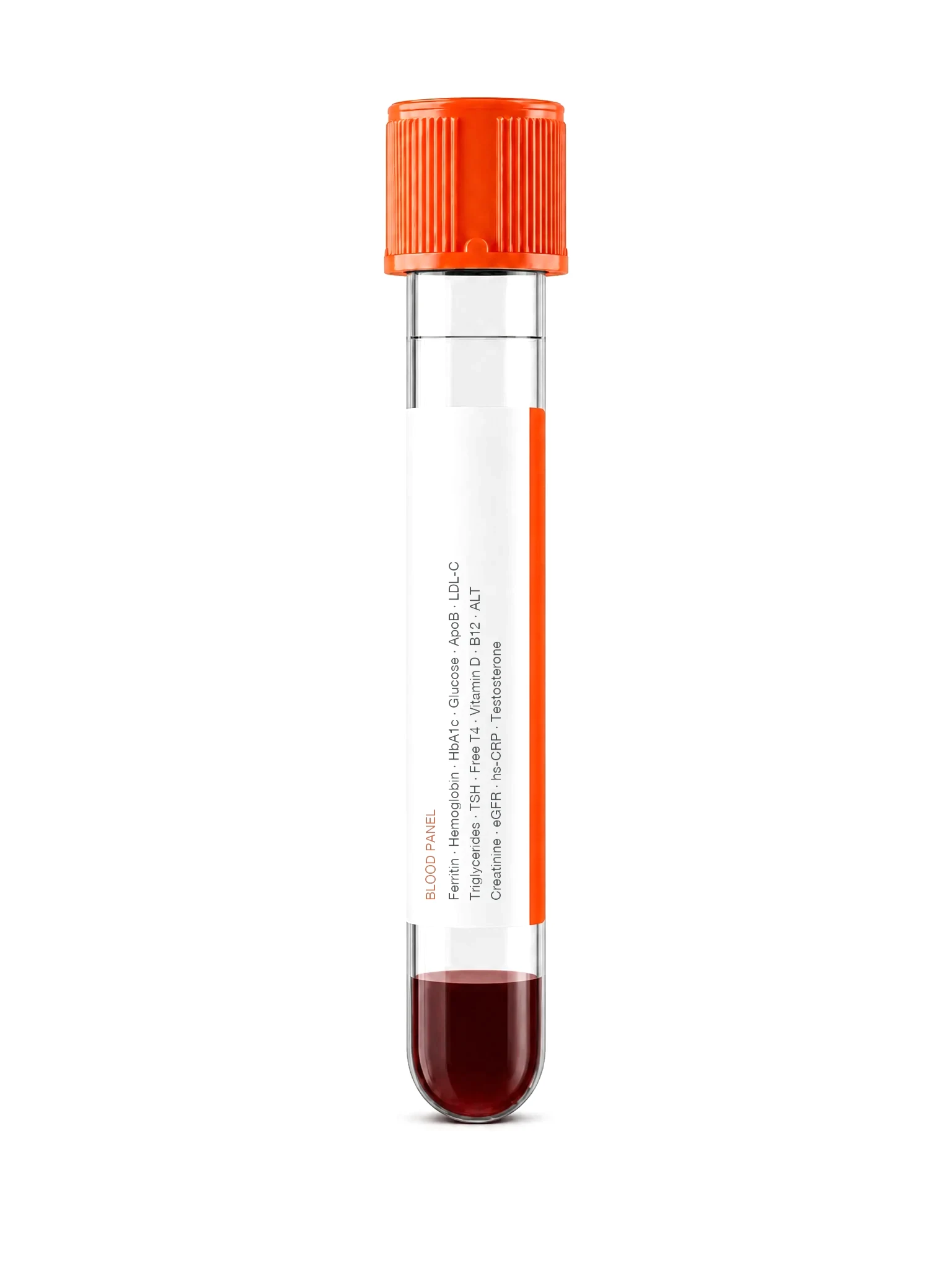
Several routine blood markers moved in a predictable direction in the trials. In people with type 2 diabetes, A1C, the three-month average of blood sugar, fell 1.4 to 1.6 points from a starting 7.7% in TRIUMPH-2, against 0.2 on placebo 4. Triglycerides and non-HDL cholesterol fell in TRIUMPH-1 3. ALT and GGT, liver enzymes that rise when the liver is fatty, tend to drift down as liver fat clears, and liver fat fell by more than 80% in the phase 2 substudy 9.
Two markers can move the wrong way without meaning disease. Lipase and amylase, enzymes from the pancreas, can rise mildly on drugs in this class with no symptoms 14; the pattern that points to pancreatitis is a large rise together with severe upper belly pain, and belly pain like that needs same-day care whatever the lipase result. Creatinine can rise and eGFR, the kidney filtering rate, can dip after days of vomiting or diarrhea, because the kidneys are short of fluid; a rise in creatinine or fall in eGFR needs review by the trial team or a doctor. There is no official monitoring schedule for retatrutide; for the approved drugs in the class, doctors usually check A1C, a lipid panel, liver enzymes and kidney function before starting. Liver enzymes, explained covers how to read the liver side, and the type 2 diabetes guide covers A1C targets.
If you have already injected retatrutide bought online, tell your doctor what you took and from whom. Tests worth asking about are A1C, a lipid panel, ALT, lipase, creatinine and eGFR, with a resting pulse and blood pressure check, so that any later change can be read against your own starting point.
Blood markers retatrutide moved in the trials

Citations
- Jastreboff AM, Kaplan LM, Frias JP et al. Triple-hormone-receptor agonist retatrutide for obesity: a phase 2 trial. N Engl J Med 2023;389:514-526.
- Jastreboff AM et al. Retatrutide, a triple hormone receptor agonist, for treatment of obesity (TRIUMPH-1). N Engl J Med 2026;395:1781-1793.
- Eli Lilly and Company. Lilly's triple agonist, retatrutide, delivered powerful weight loss in pivotal Phase 3 obesity trial (TRIUMPH-1 topline results). Press release, 21 May 2026.
- Bellido V, le Roux CW, Ekinci EI et al. Retatrutide in adults with obesity and type 2 diabetes (TRIUMPH-2): a double-blind, parallel-group, randomised, placebo-controlled, phase 3 trial. Lancet 2026;408:1455-1472.
- HCPLive. Retatrutide meets phase 3 weight loss endpoints in 2 obesity trials (TRIUMPH-2 and TRIUMPH-3 topline results; FDA submission planned for Q1 2027). 23 July 2026.
- US Food and Drug Administration. Warning letter to TXP Innovations LLC dba Tex Peptides, reference 735067, 24 August 2026.
- Eli Lilly and Company. Lilly's triple agonist retatrutide delivered weight loss of up to an average of 71.2 lbs (TRIUMPH-4 topline results). Press release, 11 December 2025.
- HCPLive. TRANSCEND-T2D-2: retatrutide beats semaglutide 2 mg on A1C and weight loss (Eli Lilly topline results, 28 October 2026).
- Sanyal AJ, Kaplan LM, Frias JP et al. Triple hormone receptor agonist retatrutide for metabolic dysfunction-associated steatotic liver disease: a randomized phase 2a trial. Nat Med 2024;30:2037-2048.
- Aronne LJ, Horn DB, le Roux CW et al. Tirzepatide as compared with semaglutide for the treatment of obesity (SURMOUNT-5). N Engl J Med 2025;393:26-36.
- Nicholls SJ, Pavo I, Bhatt DL et al. Cardiovascular outcomes with tirzepatide versus dulaglutide in type 2 diabetes (SURPASS-CVOT). N Engl J Med 2025;393:2409-2420.
- Urva S, Coskun T, Loh MT et al. LY3437943, a novel triple GIP, GLP-1, and glucagon receptor agonist in people with type 2 diabetes: a phase 1b, multicentre, double-blind, placebo-controlled, randomised, multiple-ascending dose trial. Lancet 2022;400:1869-1881.
- Rosenstock J, Frias J, Jastreboff AM et al. Retatrutide, a GIP, GLP-1 and glucagon receptor agonist, for people with type 2 diabetes: a randomised, double-blind, placebo and active-controlled, parallel-group, phase 2 trial conducted in the USA. Lancet 2023;402:529-544.
- Eli Lilly and Company. Zepbound (tirzepatide) injection, US prescribing information.
- Novo Nordisk. Wegovy (semaglutide) injection, US prescribing information.
- Wilding JPH, Batterham RL, Davies M et al. Weight regain and cardiometabolic effects after withdrawal of semaglutide: the STEP 1 trial extension. Diabetes Obes Metab 2022;24:1553-1564.
- Aronne LJ, Sattar N, Horn DB et al. Continued treatment with tirzepatide for maintenance of weight reduction in adults with obesity: the SURMOUNT-4 randomized clinical trial. JAMA 2024;331:38-48.
- ClinicalTrials.gov. NCT06662383: a study of retatrutide compared with tirzepatide in adults with obesity (TRIUMPH-5).
- BioPharma Dive. Lilly, with new data, to seek FDA approval of obesity drug retatrutide. 23 July 2026.
- Medicines and Healthcare products Regulatory Agency (MHRA). No summer shortcut for safe weight loss. 24 July 2026.
- World Anti-Doping Agency. The Prohibited List (section S0, non-approved substances).
- Lincoff AM, Brown-Frandsen K, Colhoun HM et al. Semaglutide and cardiovascular outcomes in obesity without diabetes (SELECT). N Engl J Med 2023;389:2221-2232.
Educational context only, not medical advice or a diagnosis. Always discuss your results with a clinician.