- 01Activity is the dose; fitness is the result you can measure
Minutes of exercise are what you put in. VO2 max, grip strength and balance are what your body becomes, and they are measured on a treadmill, a grip meter or a stopwatch rather than recalled from memory. Those measured abilities separate death risk widely: about 5 times between the least and most fit 2, and 84% higher with a failed 10-second one-leg stand 6. Track the abilities, and use the weekly minutes as the way to move them.
In a Cleveland Clinic study of 122,007 people who ran a treadmill test, the least fit had about five times the death risk of the fittest over a median of 8.4 years, a bigger gap than smoking showed in the same data 2. Fitness is one of the strongest numbers anyone can change, and it adds healthy years as well as years. The way to change it is exercise in four forms: cardio, strength, balance and plain daily movement.
Why fitness predicts how long you live
Physical activity is what you do; physical fitness is what your body can do as a result. Fitness is measured on a treadmill, a grip meter (dynamometer) or a stopwatch, so it carries far less error than a questionnaire about your week. That is one reason fitness studies show such large gaps in death risk.
Cardiorespiratory fitness, often written as VO2 max (the most oxygen your body can use per minute at all-out effort), is the clearest example. In the Cleveland Clinic cohort, death risk fell at every step up the fitness ladder, and the elite group still did better than the high group 2. A 2009 JAMA meta-analysis by Kodama and colleagues put the gradient in round numbers: each 1-MET gain in fitness (one MET is the energy you burn sitting still) was linked to about 13% lower death from any cause and 15% fewer heart and stroke events 7.
Cardiorespiratory fitness is inversely associated with long-term mortality with no observed upper limit of benefit.Mandsager et al., JAMA Network Open, 2018 2
In the PURE study, published in The Lancet in 2015, grip strength predicted cardiovascular death better than systolic blood pressure did 8. In a Brazilian cohort of adults aged 51 to 75, failing a 10-second one-leg stand was linked to an 84% higher death risk after allowing for age, sex and health conditions 6. Grip and balance are readouts of how well muscle, heart, nerves and lungs work together; these studies cannot show that improving them causes a longer life.
 CalculatorVO2 max calculatorEstimate your VO2 max from a field test or resting heart rate and see how it compares for your age.Work it out
How much exercise for longevity, and when it stops adding
WHO's 2020 guideline sets the floor at 150 to 300 minutes of moderate activity (brisk walking, where you can talk but not sing) or 75 to 150 minutes of vigorous activity (running or hard cycling, where you can say only a few words), plus muscle-strengthening on 2 or more days 1. For anyone below that line, the guideline says this directly.
Doing some physical activity is better than doing none.WHO Guidelines on Physical Activity and Sedentary Behaviour, 2020 1
| Activity | Weekly dose | Linked outcome | Source |
|---|---|---|---|
| Some moderate aerobic | Below 150 min | About 20% lower death risk than none | Arem et al., 2015 9 |
| Moderate aerobic | 150 to 300 min (the WHO range) | 31% lower death risk | Arem et al., 2015 9 |
| Moderate aerobic, more | 300 to 600 min (2 to 4 times the minimum) | 26% to 31% lower death risk | Lee et al., 2022 4 |
| Vigorous aerobic, more | 150 to 300 min (2 to 4 times the minimum) | 21% to 23% lower death risk | Lee et al., 2022 4 |
| Muscle-strengthening | 30 to 60 min | 10% to 17% lower risk of death, heart disease, cancer and diabetes; benefit fades at higher doses | Momma et al., 2022 3 |
| Daily steps | 6,000 to 8,000 (60+); 8,000 to 10,000 (under 60) | Death risk falls, then levels off | Paluch et al., 2022 5 |
| Balance and strength, older adults | 3 or more days | About 23% fewer falls | Sherrington et al., 2019 10 |
More aerobic exercise did not turn harmful. Across 661,137 adults, Arem's pooled analysis found the benefit levelled off at around 3 to 5 times the minimum (39% lower death risk) with no added harm even at 10 times 9. In the Lee study, which followed 116,221 adults for about 30 years, vigorous activity above 4 times the guideline gave no extra benefit and no harm 4.
Strength work is different. In Momma's 2022 meta-analysis, risk was lowest at 30 to 60 minutes a week and edged back up beyond about 130 to 140 minutes for some outcomes 3. That pattern comes from observational data and may reflect who lifts very large volumes, so the practical reading is to put extra time into cardio, balance and walking once strength work passes about an hour a week.
How to build cardio fitness and increase VO2 max
Most aerobic minutes can be easy. Zone 2 is the popular name for steady effort a little below where breathing gets ragged; the practical test is that you can still speak in full sentences. Easy work increases how much blood the heart pumps with each beat (stroke volume) and builds the muscles' mitochondria (the parts of cells that burn fuel with oxygen), and it is easy to recover from, so you can do a lot of it.
To increase VO2 max itself, add one harder session a week: intervals of 1 to 4 minutes at an effort where talking is no longer possible, with easy recovery between. If you have heart disease, diabetes, kidney disease or symptoms on exertion, agree hard intervals with a clinician first, and stop and call 911 for chest pain or pressure, fainting, or breathlessness far beyond the effort. The longevity data rest on total fitness and total activity; exact Zone 2 heart-rate bands and minute targets sold online have much less direct evidence, so treat them as one reasonable way to fill the WHO range.
 CalculatorHeart rate zones calculatorTurn your age and resting heart rate into easy, moderate and hard training zones.Work it out
Strength training for longevity and keeping muscle as you age
Muscle mass and strength start to fall from midlife, and the loss speeds up after about 60. Muscle is the main place your body stores glucose after a meal, so less muscle leaves less room for blood sugar to go; it also loads the bones, which protects against osteoporosis. When the loss goes far enough to affect strength and walking, it has a name, sarcopenia.
Two full-body sessions a week reach the major muscle groups if each includes a push, a pull, a squat or sit-to-stand, a hinge (such as a deadlift or hip bridge) and a carry. Progressive overload makes them work: add a little load, a repetition or a set when the last ones feel manageable. Older muscle builds less protein from the same meal, an effect called anabolic resistance, so protein spread across meals matters more with age. The PROT-AGE group advises 1.0 to 1.2 g of protein per kg of body weight a day for healthy adults over 65, with about 25 to 30 g at each main meal 17; if you have kidney disease, check your target with your clinician first.
 CalculatorProtein calculatorSee a daily protein range for your weight and training, split across meals.Work it out
Creatine and resistance training
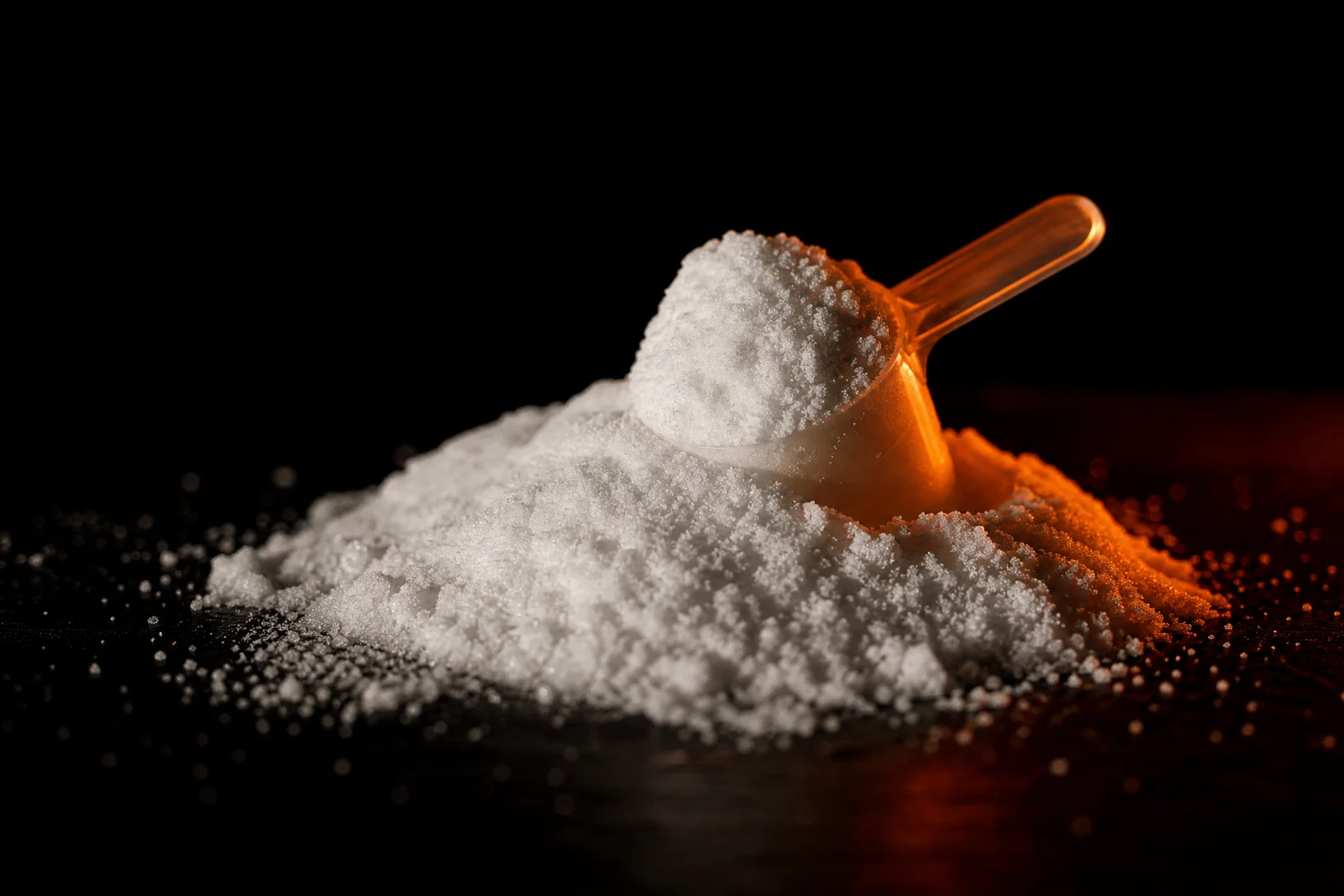 Strongest evidenceCreatineIn a meta-analysis of trials in older adults, creatine added to resistance training gave larger gains in strength and lean mass than training alone [[16]]. It raises serum creatinine on a blood test, and studies in healthy people have not shown kidney harm; anyone with kidney disease, or taking medicines that affect the kidneys, should ask a clinician before using it.In our shop
Balance, power and the skills that keep you independent
Falls are a major cause of injury in older adults, and they are partly preventable. A 2019 Cochrane review led by Sherrington found exercise programmes for older people living at home cut the rate of falls by about 23%, with balance and functional training doing most of the work 10. WHO asks adults 65 and over to do mixed sessions that combine balance and strength (it calls this multicomponent activity) on 3 or more days a week 1.
Power, the ability to produce force quickly, fades faster than strength and decides whether you catch yourself after a trip. Power training includes rising briskly from a chair, stepping up stairs without a rail and, for people able to do them, controlled jumps. The one-leg stand is the simplest test: barefoot, arms by your sides, eyes looking straight ahead, the free foot resting on the back of the standing leg, for 10 seconds 6. Stand next to a wall, counter or sturdy chair you can grab, and stop if you feel unsteady.
 CalculatorOne-leg balance testTime your one-leg stand, next to a wall or counter you can hold, and see how it compares with people your age.Work it out
Steps, sitting and exercise snacks
Daily steps give the same lesson as the dose table. Pooling 15 cohorts of 47,471 adults, Paluch and colleagues found death risk fell as steps rose, then levelled off at about 6,000 to 8,000 steps a day for adults 60 and over and 8,000 to 10,000 for younger adults 5.
Sitting matters less once you move enough. A 2016 Lancet meta-analysis of more than a million adults by Ekelund found that 60 to 75 minutes a day of moderate activity appeared to remove the extra death risk linked to sitting more than 8 hours a day 11. For people who never set aside time to exercise, short bursts still count: in UK Biobank wearable data, about three 1 to 2 minute bursts a day of vigorous everyday activity (hurrying up stairs, a fast walk to the bus, carrying heavy shopping) were linked to 38% to 40% lower death from any cause and from cancer, and 48% to 49% lower cardiovascular death 12. These are associations, and people able to hurry upstairs may be healthier to start with.
What exercise does inside the body
| Mechanism | What changes | How strong the evidence is |
|---|---|---|
| Insulin sensitivity | Working muscle takes up glucose without needing insulin; one session helps for a day or two | Strong |
| Mitochondria | More of them, working better, especially with endurance work | Strong |
| Inflammation | Resting hs-CRP tends to fall with regular training | Moderate |
| Mood | Fewer depressive symptoms in trials | Strong for symptoms |
| Senescent cells and epigenetic clocks | Fewer senescent cells in animal studies; clocks read younger in fitter people | Early or mixed |
Insulin sensitivity improves first, which is why exercise sits at the centre of the plan for insulin resistance and why muscle matters for metabolic health. Working muscle also releases signalling proteins called myokines; the best known, IL-6 (interleukin-6, a messenger protein), rises during exercise and is followed by anti-inflammatory signals. Regular training tends to lower resting hs-CRP (high-sensitivity C-reactive protein, a blood marker of low-grade inflammation); see inflammation markers explained.
Mood responds too. As our depression guide puts it, "walking or jogging, yoga and strength training each reduced depression" in a 2024 BMJ review that compared 218 trials, with bigger effects at higher intensity 18. Fitter people also have lower dementia risk in cohort studies, though those studies show a link, not proof of cause.
The links to the biology of ageing are more speculative. Senescent cells, damaged cells that stop dividing but keep sending out inflammatory signals, fall with exercise in animal studies and a few small human trials; cellular senescence covers what is known. Epigenetic clocks, which estimate biological age from chemical tags on DNA (methylation), tend to read younger in fitter people, but intervention trials are small and mixed; see epigenetic clocks and the wider map in the hallmarks of aging.
A simple longevity exercise plan, week by week
The sample weeks below show how the guideline doses fit into a real week at three starting points. Adapt them, and if you have heart, lung, kidney or blood-sugar problems, agree the starting point with a clinician.
| Starting point | Cardio | Strength | Balance and power | How to progress |
|---|---|---|---|---|
| Beginner (little or no exercise) | 10-minute brisk walks most days, building towards 150 min a week | 2 short full-body sessions: sit-to-stand, wall push-ups, rows with a band | One-leg stands at the kitchen counter | Add 5 to 10 minutes of walking a week; add a set or a rep before adding weight |
| Already active | 150 to 300 min, mostly easy, plus one interval session | 2 to 3 full-body sessions with progressive load | Step-ups, single-leg work, short jumps if joints allow | Change one thing at a time: time, load or intensity |
| 65 and over | 150 min moderate, spread across the week | 2 sessions, including chair rises and carries | 3 days of mixed balance and strength work 1 | Make balance harder (eyes closed, softer surface) with support within reach |
The same programme produces different results in different people. In the HERITAGE Family Study, 20 weeks of identical training raised VO2 max by almost nothing in some people and by more than 1 litre a minute in others, and roughly half of that spread was heritable 13. A low responder usually still improves blood pressure, insulin sensitivity or strength, so a flat VO2 max reading is a cue to change the type of training and keep going.
Training gains are built during rest days and sleep. To recover faster, keep easy days between hard ones, avoid stacking two hard days, eat protein after sessions and protect your sleep; how much sleep you need and deep sleep cover the repair window. Persistent fatigue, falling performance, poor sleep and a rising resting heart rate over weeks can signal overtraining syndrome.
How to tell exercise is working
Home tests track the abilities that predict survival. Repeat them every 3 to 6 months and watch the trend.
| Test | What it measures | What to look for |
|---|---|---|
| VO2 max estimate from a walk or run test | Aerobic fitness | Rising over months; compare with your age group |
| Grip strength on a grip meter | Overall strength | Under 27 kg (men) or 16 kg (women) is low by the European sarcopenia definition 19 |
| 10-second one-leg stand, next to support | Balance | Holding 10 seconds; failing it is linked to higher death risk 6 |
| Chair rises in 30 seconds | Leg strength and power | More rises than last time |
| Resting heart rate or HRV from a wearable | Fitness and recovery | Resting heart rate drifting down, HRV drifting up |
A DEXA scan (a low-dose X-ray body composition scan) measures lean mass and visceral fat more precisely if you have access to one, and the lean body mass calculator gives a rough estimate at home.
Blood markers regular training tends to improve
The exercise before a blood test page covers timing marker by marker, and blood tests for athletes covers what heavy training changes. One reading tells you little, because trends beat single readings: compare like with like, at the same lab and the same time since training.
Starting later, sore joints and limited mobility
No age is too late for gains. In a 1990 JAMA trial by Fiatarone and colleagues, nursing-home residents aged 86 to 96 roughly doubled their leg strength in 8 weeks of strength training and walked faster 15. A sedentary 60-year-old has more to gain from the first 150 minutes than a fit 40-year-old has from the next 150.
Joint pain changes the type of exercise more than the amount: cycling, swimming, water walking and machine-based strength work load the heart and muscles while sparing sore knees and hips. People who cannot stand for long can use chair-based strength work, an arm-cycling machine (arm ergometer) or water exercise. If you have heart disease, heart failure, diabetes, kidney disease or symptoms on exertion, agree a starting point with a clinician before vigorous work; after a heart event or with heart failure, ask about cardiac rehabilitation, a supervised exercise programme. Walking and light strength work are usually a safe place to begin.
Citations
- World Health Organization. WHO Guidelines on Physical Activity and Sedentary Behaviour. Geneva: WHO; 2020.
- Mandsager K, Harb S, Cremer P, et al. Association of cardiorespiratory fitness with long-term mortality among adults undergoing exercise treadmill testing. JAMA Netw Open. 2018;1(6):e183605.
- Momma H, Kawakami R, Honda T, Sawada SS. Muscle-strengthening activities are associated with lower risk and mortality in major non-communicable diseases: a systematic review and meta-analysis of cohort studies. Br J Sports Med. 2022;56(13):755-763.
- Lee DH, Rezende LFM, Joh HK, et al. Long-term leisure-time physical activity intensity and all-cause and cause-specific mortality: a prospective cohort of US adults. Circulation. 2022;146(7):523-534.
- Paluch AE, Bajpai S, Bassett DR, et al. Daily steps and all-cause mortality: a meta-analysis of 15 international cohorts. Lancet Public Health. 2022;7(3):e219-e228.
- Araujo CG, de Souza e Silva CG, Laukkanen JA, et al. Successful 10-second one-legged stance performance predicts survival in middle-aged and older individuals. Br J Sports Med. 2022;56(17):975-980.
- Kodama S, Saito K, Tanaka S, et al. Cardiorespiratory fitness as a quantitative predictor of all-cause mortality and cardiovascular events in healthy men and women: a meta-analysis. JAMA. 2009;301(19):2024-2035.
- Leong DP, Teo KK, Rangarajan S, et al. Prognostic value of grip strength: findings from the Prospective Urban Rural Epidemiology (PURE) study. Lancet. 2015;386(9990):266-273.
- Arem H, Moore SC, Patel A, et al. Leisure time physical activity and mortality: a detailed pooled analysis of the dose-response relationship. JAMA Intern Med. 2015;175(6):959-967.
- Sherrington C, Fairhall NJ, Wallbank GK, et al. Exercise for preventing falls in older people living in the community. Cochrane Database Syst Rev. 2019;1:CD012424.
- Ekelund U, Steene-Johannessen J, Brown WJ, et al. Does physical activity attenuate, or even eliminate, the detrimental association of sitting time with mortality? A harmonised meta-analysis of data from more than 1 million men and women. Lancet. 2016;388(10051):1302-1310.
- Stamatakis E, Ahmadi MN, Gill JMR, et al. Association of wearable device-measured vigorous intermittent lifestyle physical activity with mortality. Nat Med. 2022;28(12):2521-2529.
- Bouchard C, An P, Rice T, et al. Familial aggregation of VO2max response to exercise training: results from the HERITAGE Family Study. J Appl Physiol. 1999;87(3):1003-1008.
- Pettersson J, Hindorf U, Persson P, et al. Muscular exercise can cause highly pathological liver function tests in healthy men. Br J Clin Pharmacol. 2008;65(2):253-259.
- Fiatarone MA, Marks EC, Ryan ND, et al. High-intensity strength training in nonagenarians: effects on skeletal muscle. JAMA. 1990;263(22):3029-3034.
- Devries MC, Phillips SM. Creatine supplementation during resistance training in older adults: a meta-analysis. Med Sci Sports Exerc. 2014;46(6):1194-1203.
- Bauer J, Biolo G, Cederholm T, et al. Evidence-based recommendations for optimal dietary protein intake in older people: a position paper from the PROT-AGE Study Group. J Am Med Dir Assoc. 2013;14(8):542-559.
- Noetel M, Sanders T, Gallardo-Gomez D, et al. Effect of exercise for depression: systematic review and network meta-analysis of randomised controlled trials. BMJ. 2024;384:e075847.
- Cruz-Jentoft AJ, Bahat G, Bauer J, et al. Sarcopenia: revised European consensus on definition and diagnosis (EWGSOP2). Age Ageing. 2019;48(1):16-31.
Educational context only, not medical advice or a diagnosis. Always discuss your results with a clinician.