- 01Deep sleep is a share of the night, so you protect it through total sleep and the first few hours
Deep sleep minutes are total sleep multiplied by the deep sleep share. The share falls with age and is front-loaded into the first cycles of the night, so a late bedtime, a short night or a drink before bed cuts it more than any missing supplement. You cannot chase deep sleep minutes directly; you protect them by sleeping long enough, at a regular time, without things that break up the early part of the night.
Most healthy adults in their 20s and 30s get roughly 60 to 90 minutes of deep sleep a night, and by the 50s and 60s 30 to 60 minutes is common and normal 1. Deep sleep is stage N3, also called slow-wave sleep: the stretch of the night when brain waves slow into large, rolling waves of about 0.5 to 2 per second and you are hardest to wake. Most of it arrives in the first two or three sleep cycles, so for an 11 pm bedtime the bulk of a night's deep sleep is done by about 2 am. Because deep sleep is a share of the night, your deep sleep minutes rise and fall with how long you sleep, and they fall with age whatever you do.
How much deep sleep do you need?
No sleep guideline says how long you should be in deep sleep. The guideline that exists is for total sleep, and the deep sleep targets you see online are averages from lab studies, which depend heavily on age.
Adults should sleep 7 or more hours per night on a regular basis to promote optimal health.
A fair working range for a healthy adult in their 20s or 30s is about 13 to 20% of the night in deep sleep, which on a 7.5 hour night is about 60 to 90 minutes. If you sleep well, wake refreshed and your deep sleep sits a little under that, the shortfall in deep sleep is rarely the problem to solve. Signs that sleep is falling short are more telling than the number: waking unrefreshed, heavy daytime sleepiness, or needing long lie-ins at weekends.
Deep sleep by age: what is normal
The largest pooled look at lab sleep data is a meta-analysis (a study that combines many earlier studies) of 65 polysomnography studies, the lab sleep recordings with brain-wave sensors that are the reference method for scoring sleep stages. Covering people aged 5 to 102, it found the deep sleep share fell steadily through adult life until about age 60, then levelled off 1.
| Age | Typical share of the night in deep sleep | Minutes on a 7.5 hour night |
|---|---|---|
| Teens | About 20 to 25% | About 90 to 110 |
| 20s | About 15 to 20% | About 70 to 90 |
| 30s | About 13 to 18% | About 60 to 80 |
| 40s | About 11 to 16% | About 50 to 70 |
| 50s | About 9 to 14% | About 40 to 60 |
| 60 and over | About 7 to 12% | About 30 to 55 |
These bands are rounded from the age trend in the Ohayon meta-analysis 1; use them as a rough guide to what is typical for your age. Some people sit well below them. In a lab study of healthy men, deep sleep made up 18.9% of the night at ages 16 to 25 but only 3.4% at ages 36 to 50, and growth hormone released during sleep fell by about 75% over the same span 3. That was a small, all-male sample at the low end of the range, and it shows how steep the fall can be.
Different websites quote different normal ranges (60 to 110 minutes, 60 to 120 minutes, about 2 hours) because they draw on different age groups, different scoring rules and, increasingly, wearable data rather than lab recordings. Compare yourself with people your own age, and with your own past readings.
Is 30, 45 or 60 minutes of deep sleep enough?
A tracker reading only makes sense next to your age and your total sleep that night. Forty-five minutes is about 10% of a 7.5 hour night: low for a 25-year-old, typical for someone in their 50s. The same 45 minutes after 5.5 hours in bed says more about the short night than about deep sleep.
| Tracker average (2 to 4 weeks) | What it usually means | What to do with it |
|---|---|---|
| Under 30 minutes | Common over age 60. Under age 40, often short nights, alcohol, a broken first half of the night, or a device that under-reports deep sleep | Check total sleep first. If you also snore loudly or wake unrefreshed, talk to a doctor about a sleep study |
| 30 to 60 minutes | Normal for many people over 50, and in the 40s. On the low side in the 20s and 30s | If you feel rested, nothing. If not, work on total sleep and the habits below |
| 60 to 90 minutes | Typical for adults under about 40, and good at any age | Keep the routine that produces it |
| 90 minutes and over | Normal in teens. In adults, often recovery after short or missed sleep, a hard training block, or device overestimation | Usually nothing. Very long sleep with constant sleepiness is worth raising with a doctor |
Because deep sleep is mostly in the first cycles, a late bedtime with a fixed alarm costs some deep sleep and a lot of REM, while an early alarm cuts mostly REM. The sleep calculator below works out bedtimes from your wake time in whole 90 minute cycles. For what very short nights do across the board, see is 5 hours of sleep enough.
 CalculatorSleep calculatorDeep sleep minutes follow total sleep. Pick a bedtime that gives you 7 or more hours and whole cycles before your alarm.Work it out
How accurate is your Oura, Apple Watch, Whoop or Garmin deep sleep?
In a sleep lab, deep sleep is scored from EEG, a recording of brain waves taken with sensors on the scalp: a stretch of sleep counts as deep when enough of it shows big, slow waves. A ring or watch cannot read brain waves. It guesses the stage from heart rate, heart rate variability, breathing and movement, using a model trained on lab recordings.
When researchers tested seven consumer sleep trackers, including two Garmin watches and a Fitbit, against polysomnography, most were good at telling sleep from wake but less accurate at sorting sleep into stages, and performance differed between devices 4. Oura, Apple Watch and Whoop were not in that study. Treat any device's deep sleep figure as an estimate that is most useful for spotting your own trend.
| Device | What it calls deep sleep | What it calls light sleep |
|---|---|---|
| Apple Watch | Deep | Core (light sleep, stages N1 and N2) |
| Oura | Deep | Light |
| Whoop | Slow wave sleep (deep) | Light |
| Garmin | Deep | Light |
Apple's core sleep is light sleep, covered in full in what is core sleep. For deep sleep on any device, compare nights after a change (a drink, a late workout, a warm room) with nights without it.
What deep sleep does
Deep sleep is when the body releases its largest pulse of growth hormone, which supports tissue repair; in healthy men the loss of deep sleep from the late teens to midlife ran alongside a 75% fall in growth hormone secretion 3. Deep sleep also helps move new memories from short-term to long-term storage, and animal studies suggest the brain clears waste faster during sleep.
The waste-clearance work started in mice: during sleep the space between brain cells widened by about 60%, and beta-amyloid, a protein that builds up in Alzheimer's disease, cleared faster 5. Human evidence is newer. Brain scans of sleeping people showed slow waves followed by large pulses of the fluid that bathes the brain 6, and when researchers disrupted slow-wave sleep for one night with tones that did not wake people, beta-amyloid in the fluid around the brain and spine was about 10% higher the next morning 7. These are short-term effects in healthy adults; they do not show that a low tracker score causes dementia.
Deep sleep vs REM sleep
A night runs in cycles of about 90 minutes. Deep sleep fills the early cycles and REM takes over the late ones, which is why the time you go to bed and the time you wake cut into different stages.
| Cycle (11 pm bedtime) | Rough clock time | Deep sleep | REM sleep |
|---|---|---|---|
| 1 | 11 pm to 12:30 am | Longest block of the night | A few minutes |
| 2 | 12:30 to 2 am | Long block | Short |
| 3 | 2 to 3:30 am | Shorter block | Longer |
| 4 | 3:30 to 5 am | Little or none | Long |
| 5 | 5 to 6:30 am | Little or none | Longest block of the night |
| Deep sleep (N3) | REM sleep | |
|---|---|---|
| When it happens | Mostly the first 2 to 3 cycles of the night | Lengthens through the night, most in the last 2 to 3 hours |
| Brain activity | Slow, large waves; hardest to wake | Fast, wake-like activity; vivid dreams; muscles relaxed |
| Main jobs | Physical repair, growth hormone, memory consolidation | Emotional processing, learning skills, memory linking |
| What cuts it | Short nights, late bedtimes, a warm room, some sedatives | Early alarms, alcohol, some antidepressants |
| After a bad night | Rebounds first on the next sleep | Rebounds later, often on the second night |
Sleep pressure, the drive to sleep that builds with each hour awake, is discharged first as deep sleep. That is why a tracker often shows unusually high deep sleep after a short night, a long day or a hard workout. A high reading on a recovery night is normal.
Why am I not getting deep sleep?
Low deep sleep usually has more than one cause. These are the common ones, roughly in order of how often they matter, with a cue for each.
- Age. A steady fall through adult life is expected 1. Cue: you are over 40 and feel rested.
- Short or irregular sleep. Fewer hours leave less room for deep sleep, and a shifting bedtime moves the deep sleep window. Cue: total sleep under 7 hours on most nights.
- Alcohol in the evening. Alcohol shortens the time to fall asleep and tends to increase deep sleep in the first half of the night, then sleep is more broken in the second half and REM is reduced 8. Cue: high early deep sleep, then restless hours and early waking.
- Caffeine in the afternoon. In a lab trial, a large dose of caffeine (400 mg) taken 6 hours before bed still cut total sleep by more than an hour 9. Cue: coffee, tea, energy drinks or pre-workout in the 6 hours or more before bed (after about 5 pm for an 11 pm bedtime).
- A warm bedroom, late hard exercise or a heavy late meal. All three keep the body busy and core temperature up when it should be falling. Cue: you wake hot or sweaty, or go to bed full.
- A racing mind at bedtime. Stress keeps you alert into the first cycles, where most deep sleep sits. Cue: you lie awake going over the day. A 30 to 60 minute wind-down and a fixed wake time help more than lying in.
- Medicines. Benzodiazepines can lengthen sleep while reducing deep sleep; Z-drugs such as zolpidem affect deep sleep less consistently; some antidepressants and beta-blockers also change sleep stages. Cue: the change started with a new prescription. Do not stop a prescribed medicine on your own; ask the prescriber.
- Obstructive sleep apnea. Repeated breathing pauses pull you out of deep sleep many times an hour. It is common: in a large US cohort, about 10% of men aged 30 to 49, 17% of men aged 50 to 70 and 9% of women aged 50 to 70 had moderate to severe apnea 10. Cue: loud snoring, pauses or gasping seen by a partner, morning headaches, daytime sleepiness. This needs a doctor and a sleep test.
- Restless legs and limb movements. An urge to move the legs in the evening, or kicks during sleep, fragments the night; low iron stores are a common, treatable cause. Cue: crawling legs at rest. Read more on restless legs.
- Hot flushes, pain and an overactive thyroid. Night sweats around menopause, chronic pain and hyperthyroidism all break up early sleep.
How to get more deep sleep
The steps below are ordered by how much they are likely to move deep sleep and how strong the evidence is. The first two do the most because they set the size and timing of the deep sleep window.
- 1Protect total sleep and a fixed wake timeSeven or more hours 2, with the same wake time every day including weekends, gives deep sleep its full first-cycle window every night.
- 2Move most daysA meta-analysis found a single bout of exercise had a small positive effect on slow-wave sleep, and regular exercise had small benefits for total sleep and moderate benefits for sleep quality 11. Finish hard sessions a few hours before bed if they leave you wired.
- 3Warm up, then cool downA warm bath or shower 1 to 2 hours before bed helped people fall asleep faster in a meta-analysis 12, likely by speeding the drop in core temperature afterwards. Keep the bedroom cool and dark.
- 4Set a caffeine cut-offIn the lab trial, even 6 hours was not long enough to protect sleep after a large dose 9, so leave more than 6 hours between your last caffeine and bed. For an 11 pm bedtime, that means nothing after about 4 to 5 pm, and earlier if you drink a lot or feel it.
- 5Keep alcohol light and earlyEven when early deep sleep looks higher after a drink, the second half of the night is more broken 8. Fewer drinks, finished well before bed, give the body time to clear the alcohol.
Supplements come after the habits above, and the evidence for deep sleep specifically is thin. Glycine has the most direct signal: in a small Japanese trial, people with poor sleep who took glycine before bed fell asleep sooner and reached slow-wave sleep sooner on a lab sleep recording 13. Magnesium trials have mostly measured sleep questionnaires, not deep sleep on EEG 14, and any benefit is perhaps likelier in people whose magnesium is low; the forms differ, as magnesium types explains. Tart cherry juice has been studied for total sleep time, not deep sleep. For valerian and other herbal sleep aids, see valerian.
Supplements studied for deep sleep
Blood tests that can explain poor deep sleep
No blood test measures deep sleep. Blood tests can find treatable things that break up sleep: low iron stores behind restless legs, an overactive thyroid, a stress hormone that stays high into the evening, or low magnesium. If you already have recent results, these are the lines worth reading with your sleep in mind.
Markers to read beside poor deep sleep
Any result flagged outside its range is one to go through with your doctor. A low ferritin with restless legs matters, since iron deficiency has causes a doctor will want to find. A clearly low magnesium is covered on magnesium deficiency.
Free, no accountRead your blood testGot recent bloods and a bad run of sleep? Read every line of your report, with ferritin, TSH and cortisol explained.Read my results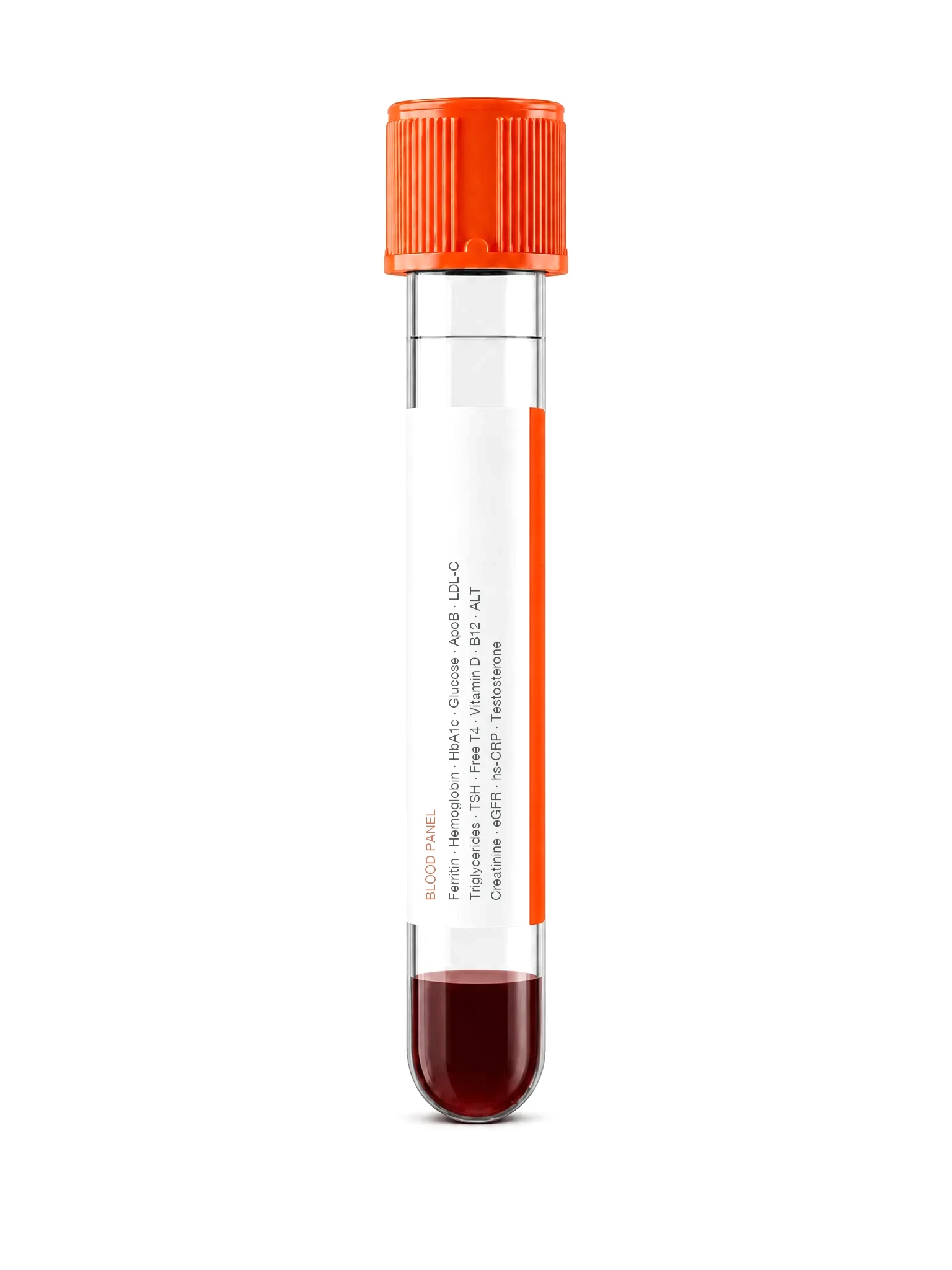
When to see a doctor
A tracker cannot diagnose a sleep disorder. A lab sleep study (polysomnography) is the only way to measure deep sleep properly; a home sleep apnea test can find apnea but does not measure sleep stages. See a doctor if any of these apply:
- Loud snoring with pauses in breathing, choking or gasping that someone else has noticed
- Morning headaches or a dry mouth most days
- Heavy daytime sleepiness despite 7 or more hours in bed, or dozing while driving
- An urge to move your legs in the evening that eases when you walk
- Trouble falling or staying asleep on most nights for 3 months or more (see can't sleep)
- Tiredness that does not lift with better sleep (see fatigue)
For the wider picture on sleep, habits, tests and supplements together, see the sleep guide.

Citations
- Ohayon MM, Carskadon MA, Guilleminault C, Vitiello MV. Meta-analysis of quantitative sleep parameters from childhood to old age in healthy individuals: developing normative sleep values across the human lifespan. Sleep. 2004;27(7):1255-1273.
- Watson NF, Badr MS, Belenky G, et al. Recommended amount of sleep for a healthy adult: a joint consensus statement of the American Academy of Sleep Medicine and Sleep Research Society. Sleep. 2015;38(6):843-844.
- Van Cauter E, Leproult R, Plat L. Age-related changes in slow wave sleep and REM sleep and relationship with growth hormone and cortisol levels in healthy men. JAMA. 2000;284(7):861-868.
- Chinoy ED, Cuellar JA, Huwa KE, et al. Performance of seven consumer sleep-tracking devices compared with polysomnography. Sleep. 2021;44(5):zsaa291.
- Xie L, Kang H, Xu Q, et al. Sleep drives metabolite clearance from the adult brain. Science. 2013;342(6156):373-377.
- Fultz NE, Bonmassar G, Setsompop K, et al. Coupled electrophysiological, hemodynamic, and cerebrospinal fluid oscillations in human sleep. Science. 2019;366(6465):628-631.
- Ju YS, Ooms SJ, Sutphen C, et al. Slow wave sleep disruption increases cerebrospinal fluid amyloid-beta levels. Brain. 2017;140(8):2104-2111.
- Ebrahim IO, Shapiro CM, Williams AJ, Fenwick PB. Alcohol and sleep I: effects on normal sleep. Alcohol Clin Exp Res. 2013;37(4):539-549.
- Drake C, Roehrs T, Shambroom J, Roth T. Caffeine effects on sleep taken 0, 3, or 6 hours before going to bed. J Clin Sleep Med. 2013;9(11):1195-1200.
- Peppard PE, Young T, Barnet JH, et al. Increased prevalence of sleep-disordered breathing in adults. Am J Epidemiol. 2013;177(9):1006-1014.
- Kredlow MA, Capozzoli MC, Hearon BA, Calkins AW, Otto MW. The effects of physical activity on sleep: a meta-analytic review. J Behav Med. 2015;38(3):427-449.
- Haghayegh S, Khoshnevis S, Smolensky MH, Diller KR, Castriotta RJ. Before-bedtime passive body heating by warm shower or bath to improve sleep: a systematic review and meta-analysis. Sleep Med Rev. 2019;46:124-135.
- Yamadera W, Inagawa K, Chiba S, et al. Glycine ingestion improves subjective sleep quality in human volunteers, correlating with polysomnographic changes. Sleep Biol Rhythms. 2007;5(2):126-131.
- Abbasi B, Kimiagar M, Sadeghniiat K, et al. The effect of magnesium supplementation on primary insomnia in elderly: a double-blind placebo-controlled clinical trial. J Res Med Sci. 2012;17(12):1161-1169.
Educational context only, not medical advice or a diagnosis. Always discuss your results with a clinician.