- 01Spirulina's trial results describe people whose numbers started high
The drops in triglycerides, LDL cholesterol, blood pressure and fasting glucose come mostly from small trials in people with raised lipids, hypertension, diabetes or metabolic syndrome. Someone whose numbers are already in range has little room to move, so the pooled averages do not predict what a spoonful does for you. The newest pooled analysis, with more trials, found the blood-fat effect no longer significant, which is what you expect when early results came from people with the most room to fall. Your own results before and after can show whether your numbers moved while you took it, though normal variation and other changes move them too; a clinician can help read the difference.
Spirulina has modest human evidence for lowering blood fats, blood pressure and fasting glucose, mainly in people who started with high numbers, from a few dozen small trials pooled into meta-analyses (studies that combine the results of earlier trials). Blood pressure is the effect that holds up best; the newest pooled analysis found the blood-fat effect no longer significant. The detox and cancer claims on labels come from preclinical work. Below are the effects in mg/dL and mmHg, the gap between the B12 on the label and what the body can use, contamination, and who should leave it on the shelf.
| Claim | Verdict | What the evidence is |
|---|---|---|
| Lowers triglycerides and LDL cholesterol | Some evidence, shrinking in newer analyses | Three meta-analyses; the 2016 and 2019 ones found drops, the 2025 one found no significant change 3413 |
| Lowers blood pressure | Some evidence | Small trials, clearest in people with hypertension; the 2025 analysis confirmed a small drop in diastolic pressure 513 |
| Lowers fasting glucose and HbA1c | Some evidence | Pooled trials in metabolic syndrome and type 2 diabetes, plus one small controlled trial 414 |
| Helps weight loss | Small effect | About 1.6 kg more lost in five small trials 6 |
| Eases hay fever, boosts endurance | Early evidence | One trial for hay fever, two small studies for endurance 7819 |
| Covers vegan B12 needs | Not supported | Most of its B12 is an inactive look-alike 9 |
| Detox, heavy metal removal, cancer prevention | Not shown in people | Preclinical studies only |
What spirulina is, and what a spoonful holds
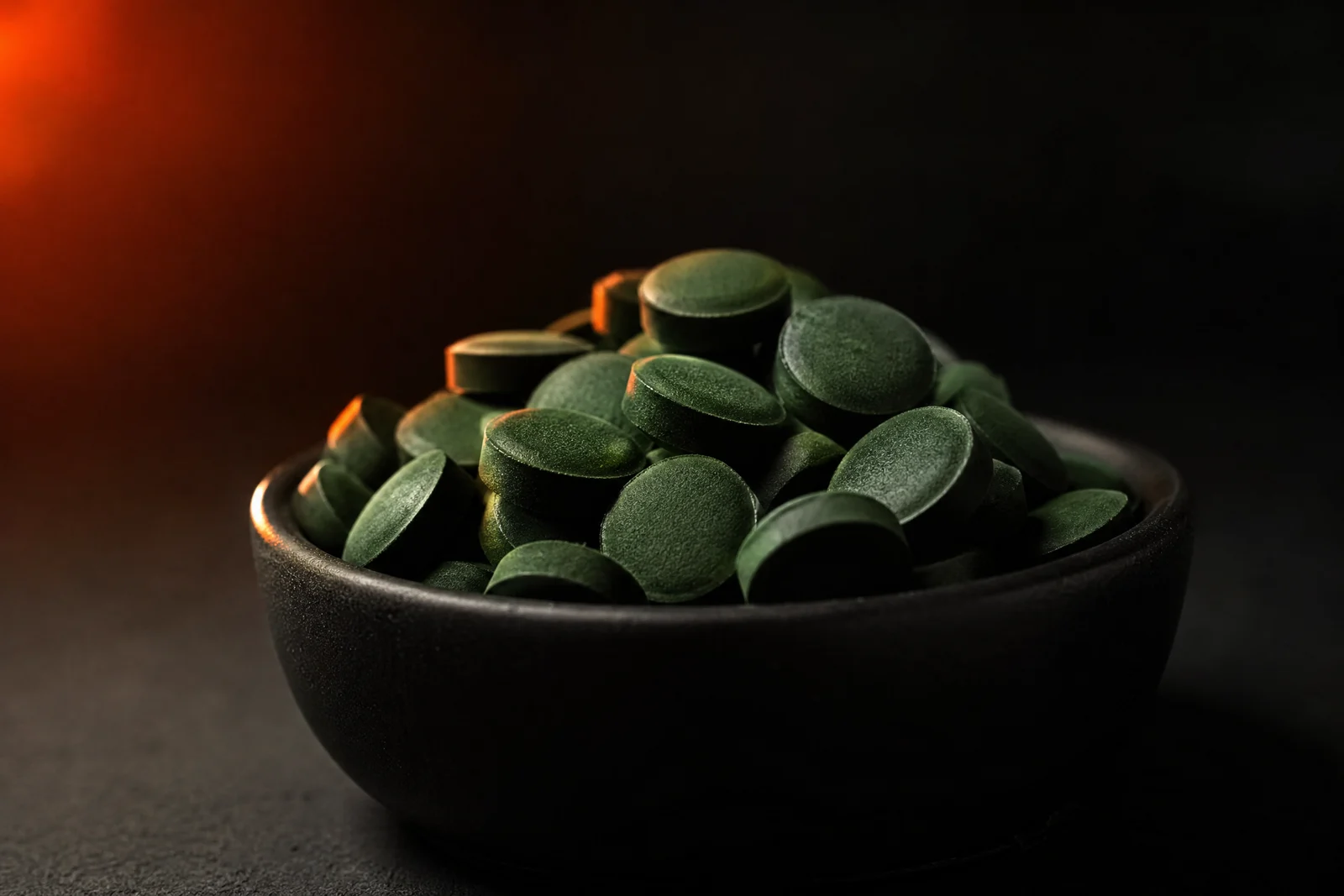
Spirulina is the dried biomass of two species of cyanobacteria, Arthrospira platensis and Arthrospira maxima 1. Cyanobacteria are photosynthetic bacteria. The old name "blue-green algae" stuck to them, but spirulina cells have no nucleus and belong with the bacteria, while chlorella is a true alga. Commercial spirulina is farmed in warm, alkaline ponds or tanks, then dried into the dark green powder pressed into tablets.
By dry weight spirulina is about 57% protein 2. People take it by the gram, so each serving delivers the nutrients of a small food. The table scales the USDA figures for dried spirulina to three common amounts.
| Per serving | 1 g | 3 g | 7 g (1 tablespoon) |
|---|---|---|---|
| Energy | 3 kcal | 9 kcal | 20 kcal |
| Protein | 0.6 g | 1.7 g | 4.0 g |
| Iron | 0.3 mg | 0.9 mg | 2.0 mg |
| Copper | 0.06 mg | 0.18 mg | 0.43 mg |
| Riboflavin (vitamin B2) | 0.04 mg | 0.11 mg | 0.26 mg |
| Sodium | 10 mg | 31 mg | 73 mg |
| Phenylalanine | 28 mg | 83 mg | 194 mg |
| Vitamin B12 (USDA value) | 0 | 0 | 0 |
| EPA and DHA (omega-3) | 0 | 0 | 0 |
Two rows in that table matter more than the rest. USDA lists zero vitamin B12 for spirulina, even though many labels list several times the daily need; the B12 section below explains the gap. Spirulina also has no EPA or DHA, the omega-3 fats in fish oil and algae oil, so it cannot stand in for either (fish oil vs algae oil compares those two). "Blue spirulina" powders are an extract of its blue pigment, phycocyanin, used mainly as a food colour; they are not whole spirulina, and the trials below used whole spirulina.
Does spirulina lower cholesterol and triglycerides?
Spirulina may lower raised blood fats a little, and the estimate has shrunk as more trials came in. A 2016 meta-analysis combined 7 randomised controlled trials with 522 participants. Spirulina lowered total cholesterol by about 47 mg/dL, LDL cholesterol by about 41 mg/dL and triglycerides by about 44 mg/dL, and raised HDL cholesterol by about 6 mg/dL 3. The size of the effect did not depend on the amount given, but longer use was linked with larger changes 3.
The 2016 LDL figure looks like a statin's effect, and it deserves caution. The pooled trials were small and short, and several enrolled people with raised lipids, diabetes or other conditions that left more room to fall. A 2019 meta-analysis limited to metabolic syndrome (a cluster of raised blood pressure, blood sugar, triglycerides and waist size) and related disorders found about half the LDL effect: LDL down about 19 mg/dL, total cholesterol down about 20 mg/dL and HDL up about 1.4 mg/dL 4. A 2025 meta-analysis of 9 spirulina trials found no significant change in blood fats, only a non-significant downward trend in total cholesterol 13. The pooled lipid results shrink as the analyses get newer, so treat spirulina as a possible small nudge to raised blood fats.
Two uncontrolled studies, in which everyone took spirulina, show the kind of change people saw. On 4.5 g a day for 6 weeks, 36 adults' triglycerides fell from about 234 to 168 mg/dL 15; on 1 g a day for 12 weeks, 52 adults with raised lipids saw triglycerides fall about 16% and LDL about 10% 16. With no comparison group, some of those drops may come from chance or other changes.
| Outcome | Pooled change with spirulina | Trials behind it | Source |
|---|---|---|---|
| Total cholesterol | Down 46.8 mg/dL (down 20.5 in metabolic syndrome) | 7 trials, 522 people; separate metabolic syndrome analysis | 34 |
| LDL cholesterol | Down 41.3 mg/dL (down 19.0 in metabolic syndrome) | Same | 34 |
| Triglycerides | Down 44.2 mg/dL | 7 trials, 522 people | 3 |
| HDL cholesterol | Up 6.1 mg/dL (up 1.4 in metabolic syndrome) | Same | 34 |
| Blood fats, 2025 analysis | No significant change; total cholesterol trended down | 9 trials | 13 |
| Fasting glucose | Down 10.3 mg/dL | Metabolic syndrome and related disorders | 4 |
| Blood pressure | Systolic down 4.6 mmHg, diastolic down 7.0 mmHg; diastolic drop confirmed in 2025 | 5 trials, 230 people; 9 trials in 2025 | 513 |
| Body weight | Down 1.6 kg (2.1 kg in obesity) | 5 trials | 6 |
No trial has counted heart attacks, strokes or deaths on spirulina, and those outcomes decide whether a cholesterol treatment is worth taking. Statins have those outcome trials (see statins and rosuvastatin); spirulina has changes in blood numbers over a few weeks. For someone with high cholesterol, spirulina is a food-level extra to raise with a clinician and never a swap for a prescribed medicine. Diet changes with their own trial record are in foods that lower cholesterol.
The lipid lines spirulina can move
A lipid panel from before and after starting spirulina can show whether your numbers moved, though a single pair of results cannot prove spirulina caused the change. Blood fats shift over weeks, so a repeat panel 8 to 12 weeks after starting, drawn the same way as the first (same fasting state, similar diet, no new medicines), gives a fairer comparison. If you have raised lipids or take a cholesterol medicine, plan the repeat test with your clinician. How to read your lipid panel explains each line, and cholesterol vs triglycerides covers why the two can move separately.
 CalculatorLDL calculatorIf your report lists total cholesterol, HDL and triglycerides but no LDL, this estimates LDL so you can compare the before and after panels.Work it out
Spirulina and blood pressure
Blood pressure is the result that holds across analyses. A 2021 meta-analysis of 5 randomised trials (230 people taking 1 to 8 g a day for 2 to 12 weeks) found systolic pressure about 4.6 mmHg lower and diastolic pressure about 7.0 mmHg lower with spirulina, with the clearest effect in people with hypertension 5. The 2025 analysis of 9 trials also found diastolic pressure slightly lower, though by an amount its authors called small and of uncertain clinical importance 13. For scale, the DASH diet combined with low salt lowered systolic pressure by about 11.5 mmHg in people with hypertension compared with a typical US diet 17. If you take blood pressure medicine, tell your prescriber before adding spirulina, because the effects can add together. High blood pressure covers the readings and the treatments with outcome evidence.
Spirulina, blood sugar and type 2 diabetes
In the 2019 meta-analysis of people with metabolic syndrome and related disorders, spirulina lowered fasting plasma glucose by about 10 mg/dL and fasting insulin slightly 4. In one controlled trial of 25 people with type 2 diabetes, 2 g a day for 2 months lowered fasting glucose and HbA1c 14. A 10 mg/dL drop matters to someone sitting at 140 mg/dL and disappears into day-to-day noise for someone at 88 mg/dL.
Anyone taking medicine for type 2 diabetes, insulin above all, should talk to the prescriber before starting spirulina, since extra glucose lowering raises the chance of a low blood sugar. Signs of a low include shakiness, sweating, a fast heartbeat, hunger, confusion or blurred vision. Check your glucose if you can and treat it as your care plan says. Confusion, a seizure or passing out needs emergency care (call 911).
Fasting glucose and HbA1c show whether anything changed; HbA1c reflects about three months of blood sugar, so it needs that long to move, and A1C vs fasting glucose explains why the two need different retest windows. Berberine has a larger trial record for glucose, with its own drug interactions.
Spirulina for weight loss, exercise and allergies
A 2019 meta-analysis of 5 small randomised trials found about 1.6 kg more weight lost with spirulina, about 2.1 kg in people with obesity, plus small drops in body fat percentage and waist size; BMI did not change significantly 6. A couple of kilograms over several weeks is a real but small effect.
The endurance evidence is two small studies. In a crossover trial (each man took spirulina and placebo in turn) in 9 moderately trained men, 6 g a day for 4 weeks stretched the final push to exhaustion after a 2-hour run from about 2.1 to 2.7 minutes, and fat burning during the run was about 11% higher 7. In 16 untrained students, 3 weeks of spirulina lowered a blood marker of oxidative stress after an all-out treadmill test and lengthened time to exhaustion 19. Studies this size are too small to generalise from.
Hay fever has one larger trial: 129 people with allergic rhinitis took 2 g a day or placebo for 6 months, and spirulina improved nasal discharge, sneezing, congestion and itching 8. The result has not been widely repeated, and evidence that spirulina lowers hs-CRP or other inflammation markers is thin. The immune activity behind the hay fever result is also the reason for the autoimmune warning further down.
Is spirulina a good source of B12 and iron for vegans?
Spirulina is a poor source of vitamin B12. Japanese researchers measured the B12 in spirulina tablets two ways: with a microbial test that counts many B12-like compounds, and with a test based on intrinsic factor, the protein your gut uses to absorb real B12. The microbial test read 6 to 9 times higher 9. When the team purified the compounds that did bind intrinsic factor, most of it was pseudovitamin B12, a look-alike the human body cannot use 9.
The major (83%) and minor (17%) analogues were identified as pseudovitamin B(12) and vitamin B(12), respectively.Watanabe F et al., Journal of Agricultural and Food Chemistry, 1999 9
A spirulina label that promises several times the daily B12 is usually reporting the inflated microbial number. Someone on a plant diet who counts on spirulina for B12 can drift into B12 deficiency, which can damage nerves before it shows up as anemia. Chlorella, often sold next to spirulina, is unreliable for a different reason, because its B12 content varies widely between products (see the comparison below).
A supplement with a stated amount of B12, or fortified foods, is the dependable route on a plant diet. Vitamin B12 forms compares cyanocobalamin, methylcobalamin and the others, and vegan nutrient deficiencies covers the other common gaps.
Related compounds
Iron is simpler. A tablespoon of spirulina gives about 2 mg of iron 2, roughly a quarter of the 8 mg a day men and women after menopause need, and about a ninth of the 18 mg women aged 19 to 50 need 18. That makes spirulina a useful extra on a plant diet and far too little to correct iron deficiency, which needs a cause found and a clinician's plan. Iron-rich foods lists larger sources.
Check these before trusting spirulina for B12 or iron
Spirulina vs chlorella, and taking them together
Spirulina and chlorella are sold together, often in one tablet, and they differ more than the shelf suggests. Spirulina is a cyanobacterium with a soft cell wall that digests easily. Chlorella is a single-celled green alga with a tough wall that manufacturers crack open so the body can digest it.
Spirulina vs chlorella
Taking spirulina and chlorella together gives the benefits of each and nothing more that anyone has shown: spirulina's small blood pressure effect and possible blood-fat nudge, and chlorella's iron. No trial has tested the pair against either one alone. No harm from the combination is known beyond the risks of each, but taking both means two batches of contamination testing to check and, for anyone on warfarin, chlorella's vitamin K to keep steady.
Spirulina side effects and who should not take it
Clean spirulina is well tolerated in trials; the usual complaints are bloating, loose stools, nausea and the taste. The US Pharmacopeia (USP), which sets quality standards for supplements, reviewed human trials, preclinical studies and 31 adverse event reports, and gave spirulina a Class A safety rating, its grade for ingredients not expected to pose a serious risk when properly made 1. The USP rating assumes the product is tested for contaminants.
Contamination is the real risk. Microcystins are liver toxins made by other cyanobacteria that can grow alongside the harvested species. When Oregon tested 87 blue-green algae supplements in the late 1990s, 85 contained microcystins and 63 were over the state's limit of 1 microgram per gram 10. Many of those products used Aphanizomenon flos-aquae (AFA), harvested wild from a lake where a toxic species also grows. Spirulina is usually farmed in controlled ponds or tanks, which lowers that risk, though an untested batch can still be contaminated. The FDA says microcystins at significant levels can damage the liver and kidneys, and two AFA supplements in 2018 and a beverage containing AFA in 2020 were recalled for microcystins 12.
Some people should avoid spirulina altogether, or take it only after their clinician agrees:
- Autoimmune disease, such as lupus, rheumatoid arthritis, multiple sclerosis or pemphigus. Spirulina appears to stimulate parts of the immune system in laboratory studies. In three case reports, echinacea and spirulina were implicated in two flares of pemphigus vulgaris (an autoimmune blistering skin disease), and a product combining spirulina with AFA was taken days before the onset and a severe flare of dermatomyositis (autoimmune muscle and skin inflammation) 11.
- Immune-suppressing medicine, such as transplant drugs or some arthritis treatments, because spirulina could work against them. Do not start it unless your prescriber agrees.
- Phenylketonuria (PKU), an inherited condition in which the body cannot break down the amino acid phenylalanine. A tablespoon of spirulina carries about 190 mg of phenylalanine 2, which counts against a PKU allowance.
- Pregnancy and breastfeeding. There are no safety trials, and a contaminated batch matters more.
- Children. There are no trials in children, and a toxin dose weighs more on a small body; the FDA advises checking with a pediatrician before giving children any supplement 12.
Immunostimulatory herbal supplements may exacerbate preexisting autoimmune disease or precipitate autoimmune disease in persons genetically predisposed to such disorders.Lee AN, Werth VP, Archives of Dermatology, 2004 11
Spirulina interactions with medicines
| Medicine | Why it matters | What to do |
|---|---|---|
| Immune-suppressing drugs | Spirulina's immune-stimulating activity could counter them; the evidence is case reports and laboratory studies 11 | Do not start it unless the prescriber agrees |
| Diabetes medicines, especially insulin and sulfonylureas (such as glipizide or gliclazide) | Spirulina lowered fasting glucose in trials, so the effects can add up 414 | Tell the prescriber; watch for shakiness, sweating or confusion and check glucose (see low blood sugar) |
| Blood pressure medicines | Spirulina lowered blood pressure in trials 5 | Tell the prescriber |
| Warfarin | Spirulina's vitamin K is low, under 2 mcg a tablespoon 2, far below chlorella's | Keep intake steady and tell the clinician who manages your INR (the blood-clotting test for warfarin; see clotting tests explained) |
| Statins | No known interaction, and no trial of the combination | Keep taking the statin as prescribed; mention spirulina at your next review |
How much spirulina per day, and how to choose one
No dose of spirulina has been established. The table lists the amounts the studies above used.
| Outcome studied | Amount used | Length | Source |
|---|---|---|---|
| Blood fats | 1 to 4.5 g a day in two uncontrolled studies; the 2016 pooled effect did not depend on amount | 6 to 12 weeks | 31516 |
| Fasting glucose and HbA1c | 2 g a day | 2 months | 14 |
| Blood pressure | 1 to 8 g a day | 2 to 12 weeks | 5 |
| Hay fever symptoms | 2 g a day | 6 months | 8 |
| Endurance | 6 g a day | 4 weeks | 7 |
Tablet strength varies by brand, so check the label for the amount per tablet. Powder costs less per gram and mixes into smoothies; tablets avoid the taste. No trial has compared powder with tablets.
Taking spirulina
In the US, spirulina is sold as a dietary supplement. The FDA does not approve supplements for safety or effectiveness before sale, and it asks makers to test for contaminants such as microcystins as part of good manufacturing practice 12, so quality depends on the maker. These checks separate a tested product from an untested one:
- A third-party quality seal, such as USP Verified or NSF Certified, on the bottle.
- A certificate of analysis for your batch that reports microcystins (under 1 microgram per gram) and lead, arsenic, cadmium and mercury.
- Arthrospira platensis or maxima named on the label, rather than an unnamed "blue-green algae" blend or AFA.
- No promises to cure or treat a disease or to replace medicine, which the law does not allow supplements to make; be wary of vague detox claims too.
Supplements that affect blood tests lists others that can shift a result, and supplements explained is our general guide to supplements.
Free, no accountRead your blood testHave a lipid panel from before and after spirulina? Read every line of both, free.Read my results

Citations
- Marles RJ et al. United States Pharmacopeia safety evaluation of spirulina. Critical Reviews in Food Science and Nutrition, 2011;51(7):593-604.
- USDA FoodData Central. Seaweed, spirulina, dried (SR Legacy, FDC ID 170495), full nutrient record.
- Serban MC et al. A systematic review and meta-analysis of the impact of Spirulina supplementation on plasma lipid concentrations. Clinical Nutrition, 2016;35(4):842-51.
- Hamedifard Z et al. The effects of spirulina on glycemic control and serum lipoproteins in patients with metabolic syndrome and related disorders: a systematic review and meta-analysis of randomized controlled trials. Phytotherapy Research, 2019;33(10):2609-2621.
- Machowiec P et al. Effect of Spirulina Supplementation on Systolic and Diastolic Blood Pressure: Systematic Review and Meta-Analysis of Randomized Controlled Trials. Nutrients, 2021;13(9):3054.
- Moradi S et al. Effects of Spirulina supplementation on obesity: a systematic review and meta-analysis of randomized clinical trials. Complementary Therapies in Medicine, 2019;47:102211.
- Kalafati M et al. Ergogenic and antioxidant effects of spirulina supplementation in humans. Medicine and Science in Sports and Exercise, 2010;42(1):142-51.
- Cingi C et al. The effects of spirulina on allergic rhinitis. European Archives of Oto-Rhino-Laryngology, 2008;265(10):1219-23.
- Watanabe F et al. Pseudovitamin B12 is the predominant cobamide of an algal health food, spirulina tablets. Journal of Agricultural and Food Chemistry, 1999;47(11):4736-41.
- Gilroy DJ et al. Assessing potential health risks from microcystin toxins in blue-green algae dietary supplements. Environmental Health Perspectives, 2000;108(5):435-9.
- Lee AN, Werth VP. Activation of autoimmunity following use of immunostimulatory herbal supplements. Archives of Dermatology, 2004;140(6):723-7.
- US Food and Drug Administration. Blue-Green Algae Products and Microcystins.
- Pinto-Leite M, Martins D, Ferreira AC, et al. The role of Chlorella and Spirulina as adjuvants of cardiovascular risk factor control: a systematic review and meta-analysis of randomised controlled trials. Nutrients, 2025;17(6):943.
- Parikh P, Mani U, Iyer U. Role of Spirulina in the control of glycemia and lipidemia in type 2 diabetes mellitus. Journal of Medicinal Food, 2001;4(4):193-9.
- Torres-Duran PV, Ferreira-Hermosillo A, Juarez-Oropeza MA. Antihyperlipemic and antihypertensive effects of Spirulina maxima in an open sample of Mexican population: a preliminary report. Lipids in Health and Disease, 2007;6:33.
- Mazokopakis EE et al. The hypolipidaemic effects of Spirulina (Arthrospira platensis) supplementation in a Cretan population: a prospective study. Journal of the Science of Food and Agriculture, 2014;94(3):432-7.
- Sacks FM et al. Effects on blood pressure of reduced dietary sodium and the Dietary Approaches to Stop Hypertension (DASH) diet. New England Journal of Medicine, 2001;344(1):3-10.
- NIH Office of Dietary Supplements. Iron: fact sheet for health professionals (Recommended Dietary Allowances).
- Lu HK et al. Preventive effects of Spirulina platensis on skeletal muscle damage under exercise-induced oxidative stress. European Journal of Applied Physiology, 2006;98(2):220-6.
- Bito T, Okumura E, Fujishima M, Watanabe F. Potential of Chlorella as a dietary supplement to promote human health. Nutrients, 2020;12(9):2524.
Educational context only, not medical advice or a diagnosis. Always discuss your results with a clinician.