- 01Swallowed collagen is digested like any protein, and your body decides where the pieces go
Collagen peptides are broken down in the gut into amino acids and a few very short chains, which the blood carries wherever the body needs protein. You cannot steer them to your face or knees. That is why the measured effects are small and slow, why a cream cannot add collagen to the skin, and why no blood test can show a 'collagen level'.
Collagen is the most common protein in the body, the rope-like material that holds skin, tendon, bone and cartilage together. A collagen peptide powder is that protein, taken from hides, bones or fish skin and cut into short chains so it stirs into coffee. Swallowed collagen is digested like any other protein, and your body, not the label, decides where the pieces go. That is why the trial results are small: a lift in skin hydration that independent trials could not repeat, a modest drop in joint symptoms, and higher bone density in one 12-month trial.
What collagen peptides are, and how they differ from gelatin and bone broth
Collagen peptides, also sold as hydrolyzed collagen or collagen hydrolysate, are made by breaking collagen with enzymes into chains a few thousand daltons long (a dalton is the unit for molecular weight; a water molecule is 18). The body makes 28 types of collagen. Type I dominates skin, bone and tendon, type III sits alongside it in skin and blood vessels, and type II is the cartilage type. Most peptide powders are type I from bovine (cow) hide, porcine (pig) skin, marine (fish) skin and scales, or chicken.
Gelatin is the same protein broken down less, which is why it sets into a gel when cooled and peptides do not. Bone broth contains some gelatin, but the amount varies with the bones, the cooking time and the recipe, so a cup can hold a few grams or close to none. Plants make no collagen. Products labelled vegan collagen are either collagen made by engineered yeast or bacteria, or a blend of collagen builders such as vitamin C, zinc, copper and the amino acids glycine and proline.
| Form | How it is made | Amount used in trials | What it is meant to do |
|---|---|---|---|
| Collagen peptides | Collagen cut by enzymes into short chains; dissolves in hot or cold drinks | 2.5 to 15 g a day | Supply collagen amino acids and short peptides; the form used in most skin, bone and joint trials |
| Gelatin | Collagen partly broken by heat; gels when cool | 15 g in the exercise trial 11 | Same building blocks; used in the exercise and collagen-synthesis trial |
| Undenatured type II collagen (UC-II) | Chicken cartilage collagen kept intact | 40 mg a day 9 | Meant to calm the immune response in joints; the dose is too small to supply building blocks. One 180-day trial of 191 people with knee osteoarthritis found lower symptom scores than placebo 9 |
| Bone broth | Bones simmered for hours | Not tested in trials | Food with a variable, usually small, gelatin content |
| Vegan collagen | Engineered microbes, or a mix of vitamin C, zinc, copper and amino acids | Varies by product | Either a lab-made collagen or the raw materials the body uses to build its own |
Source matters for allergy and diet more than for results. Marine collagen is the option for pescatarians and the one to avoid with a fish allergy; some marine products also use shellfish, and some membrane products come from eggshell. Porcine collagen is not halal or kosher, and bovine collagen does not suit everyone, so read the source line on the label.
What happens after you swallow collagen peptides
How a scoop of collagen becomes something your body can use
Collagen peptides benefits: what the human trials show, use by use
| Use | Best human evidence | What it found | How sure we can be |
|---|---|---|---|
| Skin hydration and elasticity | Pooled analyses of 19 to 26 randomized trials 1 2 13 | Small improvement overall; none in high-quality or non-industry trials | Low to moderate; funding bias is a real concern |
| Knee and hip osteoarthritis | Pooled analysis of 5 trials, 507 people 4 | Lower total symptom and visual pain scores; no change in the pain or function subscores | Low; small trials, modest effect |
| Bone density after menopause | One 12-month placebo trial, 131 women 3 | Spine and hip bone density rose; bone markers shifted toward formation | Low; a single trial of one product |
| Muscle with strength training | One 12-week trial, 53 older men 14 | More fat-free mass and strength than training alone | Low; not repeated widely |
| Brittle nails | One open-label study, 25 people 8 | Faster growth, fewer broken nails | Very low; no placebo group |
| Hair growth | Multi-ingredient products only | Cannot separate collagen from the other ingredients | No evidence for collagen alone |
Skin
Skin is where most collagen trials sit, and the evidence splits by who paid for the work. In 2023, Pu and colleagues pooled 26 randomized trials with 1,721 people (a meta-analysis, which combines many trials into one result) and found collagen peptides improved skin hydration and elasticity compared with placebo, while flagging several sources of bias in the trials 1. A 2021 meta-analysis of 19 trials and 1,125 people, 95% of them women, reached a similar conclusion after about 90 days of use 13. In 2025, Myung and Park pooled 23 trials with 1,474 people. All 23 together showed a benefit. The trials without pharmaceutical-company funding showed no effect on hydration, elasticity or wrinkles, and neither did the high-quality trials 2.
There is currently no clinical evidence to support the use of collagen supplements to prevent or treat skin aging.Myung SK and Park Y, American Journal of Medicine, 2025 2
A fair reading is that if collagen peptides help skin, the effect is small enough that independent trials have not been able to find it. Oral hyaluronic acid has its own small set of skin trials; the popular collagen and hyaluronic acid pair has not been tested as a combination.
Hair and nails
Hair and nails are made of keratin, a different protein, and keratin depends on cysteine, an amino acid collagen barely contains. The best nail data is an open-label study by Hexsel and colleagues: 25 people with brittle nails took 2.5 g of collagen peptides daily for 24 weeks, and nail growth rose 12% while broken nails fell 42% 8. Everyone knew they were taking collagen and there was no placebo group, so the result is a lead that still needs a placebo-controlled trial. Hair trials that report benefit tested blends of collagen with vitamins and minerals, and nothing suggests collagen changes pattern hair loss, which is driven by hormones and genes.
Joints
In a 24-week trial of 147 college athletes, Clark and colleagues found 10 g a day of collagen peptides reduced activity-related joint pain compared with placebo 7. In knee or hip osteoarthritis (wear-and-tear arthritis), a 2019 meta-analysis of 5 trials and 507 people found the total WOMAC symptom score fell 8 points and a visual pain-scale score fell about 17 points versus placebo, but the WOMAC pain and function subscores did not change 4. The trials are small and the change is modest. Joint pain with swelling, heat, redness or fever needs a clinician's assessment before any supplement.
Bone
The strongest single collagen trial is in bone. König and colleagues gave 131 postmenopausal women with reduced bone density 5 g of a specific collagen peptide or placebo daily for 12 months. Bone density rose at the spine and at the femoral neck (the top of the thigh bone, where hip fractures happen). P1NP, a marker of bone building, rose in the collagen group, and CTX, a marker of bone breakdown, rose only in the placebo group, meaning breakdown sped up without collagen and held steady with it 3. It is one trial of one branded product with 102 women finishing it, and it does not replace calcium, vitamin D, exercise or the medicines proven to cut fracture risk in osteoporosis.
Tendons and muscle
Shaw and colleagues gave 8 healthy men 15 g of vitamin C-enriched gelatin an hour before 6 minutes of rope skipping, and the blood marker of collagen synthesis, P1NP, doubled compared with placebo 11. In 53 older men with sarcopenia (age-related muscle loss), 15 g of collagen peptides a day plus 12 weeks of resistance training produced more fat-free mass and strength than training with placebo 14. Both results come from small groups, and in the muscle trial the training did most of the work.
Wounds and recovery
In 89 nursing-home residents with pressure ulcers, a fortified collagen peptide drink taken 3 times a day roughly doubled the rate of healing over 8 weeks compared with placebo 15. The drink carried other nutrients too, and many such residents are short of protein, so collagen's own share is unclear. There is no evidence that collagen speeds up everyday cuts or surgical scars in well-fed adults. A wound that is spreading, hot, oozing pus or paired with fever needs medical care the same day; slow wound healing covers the blood tests behind it.
How much collagen per day the trials used, and how long it takes to work
Trials of collagen peptides used between 2.5 g and 15 g a day, and the amount tracked the goal. The table lists what each trial gave and measured. Whether any amount suits you, alongside your medicines and health conditions, is a question for your clinician.
| Goal studied | Amount given in the trial | Trial length | What was measured |
|---|---|---|---|
| Skin hydration and elasticity | Mostly 2.5 to 10 g a day 1 | 8 to 12 weeks, some to 24 | Skin moisture and springiness with instruments |
| Brittle nails | 2.5 g a day 8 | 24 weeks | Nail growth rate, broken nails |
| Activity-related joint pain | 10 g a day 7 | 24 weeks | Pain scores |
| Bone density after menopause | 5 g a day 3 | 12 months | Bone density, P1NP, CTX |
| Muscle with strength training | 15 g a day 14 | 12 weeks | Fat-free mass, strength |
| Collagen synthesis after exercise | 15 g gelatin with vitamin C 11 | 3 days | Blood P1NP |
How the trials gave collagen peptides
Most trials measured skin with instruments at 8 to 12 weeks, nail and bone trials ran 24 weeks to 12 months, and very few lasted longer, so nobody knows whether effects keep building or fade after stopping. Photos in the same light at the start and at 12 weeks are a simple way to see whether anything has changed; if nothing has by then, the trials give no reason to expect a change at 24. Gummies and capsules usually carry much less than the trials used, often under 1 g per capsule.
Do you need vitamin C with collagen?
Your body needs vitamin C to finish new collagen: two enzymes use it to lock the strands into shape, and without it collagen falls apart, which is what scurvy is. The NIH Office of Dietary Supplements sets the recommended dietary allowance (RDA) at 75 mg a day for women and 90 mg for men, with 35 mg more for smokers, and most people who eat fruit and vegetables reach it from food 16. The one human trial that tracked a collagen-synthesis marker gave gelatin with vitamin C 11, so its result belongs to the pair. There is no evidence that taking the two at the same moment matters. Iron, zinc and copper also feed the collagen-making enzymes; our vitamin C guide covers who runs low.
Collagen's cofactors

Collagen creams and serums: what they can and cannot do
Bos and Meinardi laid out the rule in 2000: "We argue that the molecular weight (MW) of a compound must be under 500 Dalton to allow skin absorption." 6 Intact collagen is around 300,000 daltons and even collagen peptides run to thousands, so collagen in a cream stays on the surface. There it holds water and leaves a smooth film, which is a real cosmetic effect that washes off. It does not add collagen to the dermis. The best evidence for protecting or building the skin's own collagen is for prescription retinoids and daily sunscreen, with smaller studies for topical vitamin C, and the copper peptide GHK-Cu has a smaller, earlier evidence base. What breaks skin collagen down faster is better established than what builds it: sunlight, smoking and years of high blood sugar, which stiffens collagen through a process called glycation.
Does collagen count toward your daily protein?
Collagen counts toward daily protein in grams, but it is an incomplete protein. It has no tryptophan, one of the essential amino acids your body cannot make, and little leucine, the amino acid that most strongly switches on muscle building, so it is a weak stand-alone protein after a workout compared with whey, eggs or soy. Paul, Leser and Oesser calculated that collagen peptides can still supply up to 36% of daily protein in a typical American diet while every essential amino acid requirement is met 5. A 10 to 20 g scoop gives roughly 9 to 18 g of protein and about 35 to 70 calories. Collagen is about one-third glycine, which is why the two are often discussed together. Our amino acids guide explains which ones count as essential.
 CalculatorProtein calculatorWork out your daily protein target in grams, then see what share a scoop of collagen would take up.Work it out
Collagen peptides side effects, and who should be careful
In trials collagen peptides were well tolerated; the complaints were mild fullness, heartburn and an unpleasant taste. Collagen itself has no well-documented drug interactions. The cautions come from what collagen is made of and what blends add to it, biotin above all.
- Allergy: marine collagen can trigger a fish or shellfish allergy, and eggshell membrane products can affect people with egg allergy. Hives, swelling of the lips, tongue or throat, or trouble breathing after any supplement is an emergency.
- Kidney disease: collagen is protein, so it counts toward any protein limit set for chronic kidney disease. Check with your kidney team before adding it; your eGFR, an estimate of how well the kidneys filter, is the number they track.
- Kidney stones: hydroxyproline in collagen is partly turned into oxalate. In volunteers, 30 g of gelatin a day raised urine oxalate by 43% compared with whey protein, and single loads of 5 to 10 g also raised it 17. If you have had calcium oxalate kidney stones, ask before taking it daily. Severe pain in the side or back, blood in the urine, or pain with fever and vomiting needs care the same day.
- Pregnancy and breastfeeding: collagen trials rarely include pregnant people, so safety data is thin. If you are pregnant or breastfeeding, ask your obstetrician, midwife or prescriber before adding it.
- Prescribed treatment: collagen is never a substitute for osteoporosis or arthritis medicines.
In the US, collagen peptides are sold as dietary supplements under the Dietary Supplement Health and Education Act of 1994, which means the FDA does not approve them for safety or effectiveness before they reach shelves. Because collagen comes from hides, bones and fish skin, contaminant testing matters, and a third-party seal such as USP Verified or NSF Certified checks that the label matches the contents and screens for common contaminants. Collagen is a food protein and is not on the World Anti-Doping Agency Prohibited List; for athletes the risk is a contaminated product, which sport-specific certification is designed to screen for.
Can a blood test show your collagen?
No blood test measures a collagen level, in your skin or anywhere else, because swallowed collagen leaves no trace of its own once it is digested. Two markers do track type I collagen in bone. P1NP is the fragment snipped off when new type I collagen is laid down, so it rises with bone building. CTX is a fragment released when bone collagen is broken down, so it rises with bone loss. Doctors use the pair to follow bone turnover and to check whether osteoporosis treatment is working; the König trial used them to show bone collagen shifting toward formation 3. They cannot tell you whether a powder is doing anything for your skin.
If your CTX is high, your P1NP is low, or a DEXA scan shows low bone density, take that to your clinician first. These markers are read together with a DEXA scan, your medicines and your history, not on their own. Ask whether your vitamin D, calcium and PTH have been checked and whether you need osteoporosis treatment; P1NP and CTX are usually rechecked about 3 to 6 months after a treatment starts to see whether it is working.
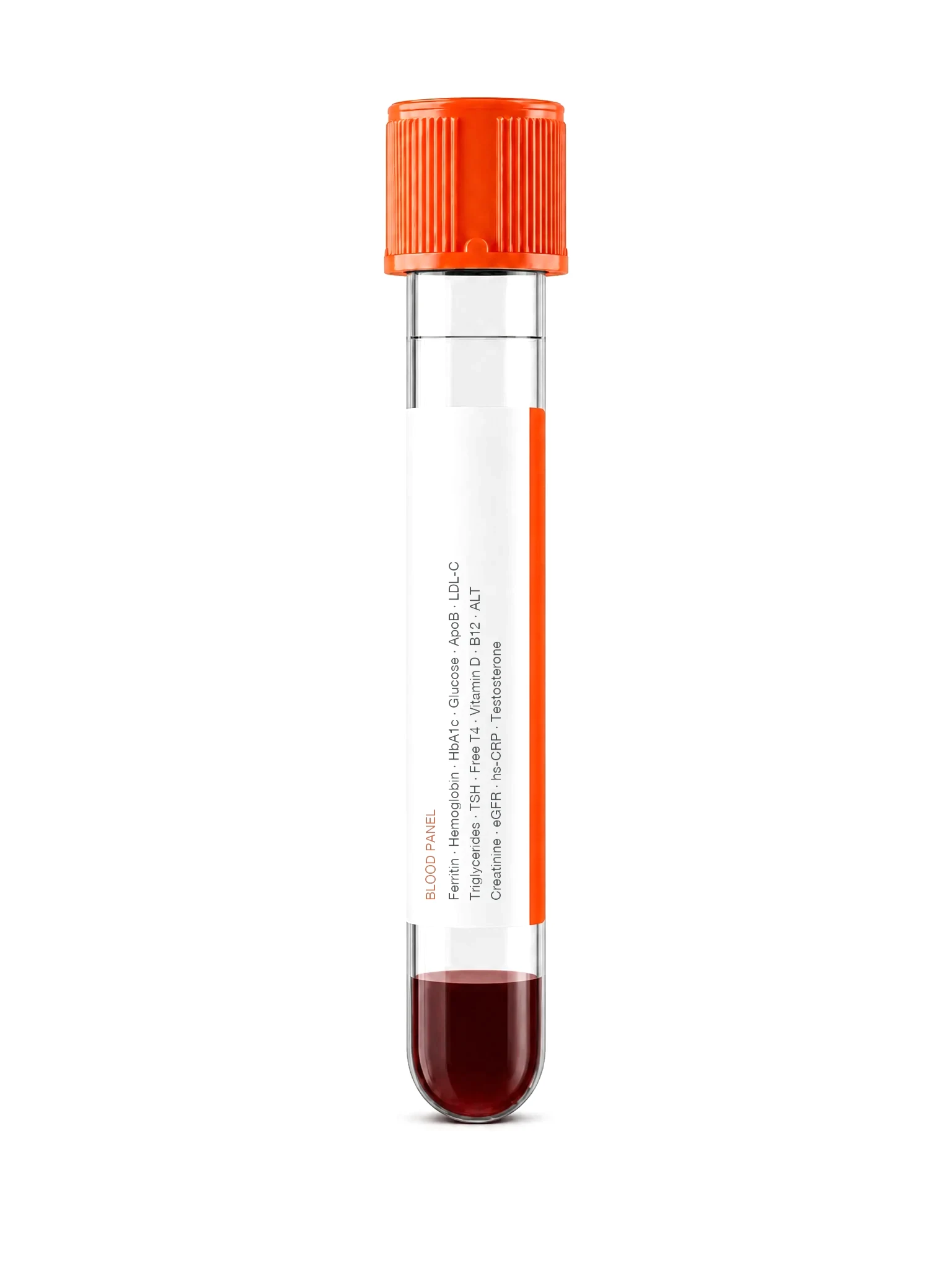
Our guide to bone tests explained covers how P1NP and CTX are read beside a DEXA scan. Around a collagen habit, the cofactors are the more relevant blood tests: vitamin C when the diet is short on fruit and vegetables or in smokers, and zinc with slow healing or little meat or seafood. Your clinician can say whether either is worth checking.
Markers to read beside collagen

Citations
- Pu SY, Huang YL, Pu CM, et al. Effects of oral collagen for skin anti-aging: a systematic review and meta-analysis. Nutrients, 2023;15(9):2080.
- Myung SK, Park Y. Effects of collagen supplements on skin aging: a systematic review and meta-analysis of randomized controlled trials. American Journal of Medicine, 2025;138(9):1264-1277.
- König D, Oesser S, Scharla S, Zdzieblik D, Gollhofer A. Specific collagen peptides improve bone mineral density and bone markers in postmenopausal women: a randomized controlled study. Nutrients, 2018;10(1):97.
- García-Coronado JM, Martínez-Olvera L, Elizondo-Omaña RE, et al. Effect of collagen supplementation on osteoarthritis symptoms: a meta-analysis of randomized placebo-controlled trials. International Orthopaedics, 2019;43(3):531-538.
- Paul C, Leser S, Oesser S. Significant amounts of functional collagen peptides can be incorporated in the diet while maintaining indispensable amino acid balance. Nutrients, 2019;11(5):1079.
- Bos JD, Meinardi MM. The 500 Dalton rule for the skin penetration of chemical compounds and drugs. Experimental Dermatology, 2000;9(3):165-169.
- Clark KL, Sebastianelli W, Flechsenhar KR, et al. 24-week study on the use of collagen hydrolysate as a dietary supplement in athletes with activity-related joint pain. Current Medical Research and Opinion, 2008;24(5):1485-1496.
- Hexsel D, Zague V, Schunck M, et al. Oral supplementation with specific bioactive collagen peptides improves nail growth and reduces symptoms of brittle nails. Journal of Cosmetic Dermatology, 2017;16(4):520-526.
- Lugo JP, Saiyed ZM, Lane NE. Efficacy and tolerability of an undenatured type II collagen supplement in modulating knee osteoarthritis symptoms: a multicenter randomized, double-blind, placebo-controlled study. Nutrition Journal, 2016;15:14.
- Iwai K, Hasegawa T, Taguchi Y, et al. Identification of food-derived collagen peptides in human blood after oral ingestion of gelatin hydrolysates. Journal of Agricultural and Food Chemistry, 2005;53(16):6531-6536.
- Shaw G, Lee-Barthel A, Ross ML, Wang B, Baar K. Vitamin C-enriched gelatin supplementation before intermittent activity augments collagen synthesis. American Journal of Clinical Nutrition, 2017;105(1):136-143.
- Verzijl N, DeGroot J, Thorpe SR, et al. Effect of collagen turnover on the accumulation of advanced glycation end products. Journal of Biological Chemistry, 2000;275(50):39027-39031.
- de Miranda RB, Weimer P, Rossi RC. Effects of hydrolyzed collagen supplementation on skin aging: a systematic review and meta-analysis. International Journal of Dermatology, 2021;60(12):1449-1461.
- Zdzieblik D, Oesser S, Baumstark MW, Gollhofer A, König D. Collagen peptide supplementation in combination with resistance training improves body composition and increases muscle strength in elderly sarcopenic men: a randomised controlled trial. British Journal of Nutrition, 2015;114(8):1237-1245.
- Lee SK, Posthauer ME, Dorner B, Redovian V, Maloney MJ. Pressure ulcer healing with a concentrated, fortified, collagen protein hydrolysate supplement: a randomized controlled trial. Advances in Skin and Wound Care, 2006;19(2):92-96.
- NIH Office of Dietary Supplements. Vitamin C: fact sheet for health professionals.
- Knight J, Jiang J, Assimos DG, Holmes RP. Hydroxyproline ingestion and urinary oxalate and glycolate excretion. Kidney International, 2006;70(11):1929-1934.
Educational context only, not medical advice or a diagnosis. Always discuss your results with a clinician.