- 01A flagged lipid result on isotretinoin is expected; the size of the rise decides what happens
A triglyceride result flagged high mid-course, somewhere between 150 and 500 mg/dL, is the drug's known effect. Across 26 studies the average level during treatment stayed near 120 mg/dL and few people crossed into high-risk ranges 8, so a mild rise usually means a recheck while the course carries on 5. Two patterns do change the plan: triglycerides that keep climbing toward 500 mg/dL, the line US guidelines call very high 9, or any rise that comes with tummy pain spreading to the back; and liver enzymes that stay up on recheck. The label says to stop isotretinoin when triglycerides cannot be controlled or pancreatitis symptoms appear 5.
On isotretinoin, the lab changes that show up most often are also the least worrying. A rise in triglycerides, cholesterol or liver enzymes during a course is expected, usually small, and generally reverses once the course ends 3. What matters is how far a result climbs and whether it comes back down on recheck. Pregnancy is a separate, absolute line: the drug causes severe birth defects, so anyone who can get pregnant is tested before and throughout the course 5. Most courses run 15 to 20 weeks, with lipid and liver tests before the first capsule and again once the dose has settled 5.
What isotretinoin is, and why people still call it Accutane
Isotretinoin is 13-cis-retinoic acid, a close chemical relative of vitamin A, taken as a capsule by mouth. Accutane was the original US brand and is no longer sold there; the same molecule is sold in the US as Absorica, Absorica LD, Amnesteem, Claravis, Myorisan and Zenatane, and as Roaccutane in the UK and Europe.
Isotretinoin is thought to act on all four drivers of acne at once, which is why it can clear acne that antibiotics and creams have left behind:
- It shrinks the oil glands and cuts oil (sebum) output sharply.
- It normalizes how skin cells line the pore, so pores clog less often.
- With less oil, the acne bacterium Cutibacterium acnes has less to feed on.
- It calms the inflammation that turns a clogged pore into a red, painful spot.
Who gets isotretinoin
In the US, the FDA-approved use is severe nodular acne that has not responded to other treatment, in people 12 and older who are not pregnant 10. The 2024 American Academy of Dermatology (AAD) guidelines go wider, giving oral isotretinoin a strong recommendation for acne that is severe, acne that scars, acne that causes psychological distress, and acne that has not cleared with standard oral or topical treatment 1. It is not used for mild acne or blackheads alone. Dermatologists sometimes use it outside the label for other oil-gland conditions, such as severe rosacea.
Some people need extra care or a different first choice. Isotretinoin is ruled out in pregnancy, and breastfeeding is not recommended during the course or for at least 8 days after the last dose 5. Diabetes, obesity, heavy drinking and a personal or family history of lipid disorders call for more frequent lipid checks 5. The label asks prescribers to check for depression and other mental health conditions before and during treatment, so a history of depression means closer follow-up rather than an automatic no 5. Women whose acne tracks their cycle, including women with PCOS, may be offered spironolactone (an off-label use for acne) or a combined birth control pill first; the AAD guideline gives both a conditional recommendation 1.
How well isotretinoin works, and whether acne comes back
Isotretinoin is the most effective acne treatment in the trial record. In 2023, Huang and colleagues pooled 221 randomized trials of 37 treatments. People on oral isotretinoin saw their total spot count fall by about 48 percentage points more than with a dummy treatment, ranking it first, ahead of triple combinations of a retinoid, benzoyl peroxide and an antibiotic 2. The evidence comes from human trials and large patient cohorts.
Acne often flares before it clears. The label notes a temporary flare, usually early in treatment 5, which is one reason many prescribers start at a lower dose and build up. Clearing usually builds through months 2 to 5, and the label lets the prescriber end the course early once nodules have fallen by more than 70% 5.
Most people stay clearer long term, and acne does return for some. In Blasiak's observational study of 180 patients at the University of North Carolina, 97.4% of those followed up said their acne had improved a year after finishing. Acne relapsed in 47.4% of those whose total dose was under 220 mg per kg of body weight, against 26.9% at 220 mg/kg or more, though a dry, itchy rash (retinoid dermatitis) was more common at the higher dose, 53.8% against 31.6% 6. Relapse there meant needing any prescription acne treatment again; only 1.72% needed a second isotretinoin course within the year 6. If relapse worries you, ask your prescriber what total dose your course is aiming for. When a second course is needed, the label asks for at least 2 months off first 5.
How an isotretinoin course is taken
Isotretinoin is prescription-only, and the prescriber sets the dose from body weight, response and side effects. The label's usual range is 0.5 to 1 mg per kg of body weight a day, split into two doses, for 15 to 20 weeks; Absorica LD uses a lower range of 0.4 to 0.8 mg/kg because more of it is absorbed 5. The traditional aim is a total of 120 to 150 mg per kg across the whole course 6. Lower fixed daily doses over a longer course are used for some moderate and adult acne; they cause fewer side effects, and the original Accutane label noted that people on lower doses needed retreatment more often 7. If you miss a dose, skip it and take the next one as usual; never take two doses at once 5.
| Body weight | Daily dose at 0.5 mg/kg | Daily dose at 1 mg/kg | Total for 120 to 150 mg/kg |
|---|---|---|---|
| 50 kg | 25 mg | 50 mg | 6,000 to 7,500 mg |
| 60 kg | 30 mg | 60 mg | 7,200 to 9,000 mg |
| 70 kg | 35 mg | 70 mg | 8,400 to 10,500 mg |
| 80 kg | 40 mg | 80 mg | 9,600 to 12,000 mg |
| 90 kg | 45 mg | 90 mg | 10,800 to 13,500 mg |
The daily doses match the label's own by-weight table 5; the totals are plain arithmetic, and your prescriber sets your actual dose. Time to reach the total does not depend on weight: about 4 to 5 months at 1 mg/kg a day, and 8 to 10 months at 0.5 mg/kg.
Food matters for most capsules. The generic capsules based on Accutane are taken with a meal: in the original Accutane label's crossover study of 74 adults, a high-fat meal more than doubled the amount of isotretinoin absorbed 7. Absorica and Absorica LD are made to be absorbed the same with or without food, and the two are not interchangeable 5. Swallow capsules whole with a full glass of liquid 5. Isotretinoin bought online without a prescription skips the pregnancy checks and the blood tests that make the drug safe to use.
Taking isotretinoin capsules
The blood tests on isotretinoin: before, during and after
Isotretinoin monitoring watches two things: whether blood fats and liver enzymes have climbed, and, for anyone who can get pregnant, whether a pregnancy has started. The label asks for a fasting lipid test and liver tests before treatment, then lipid checks until the response is known, which usually happens within 4 weeks 5. A 2016 meta-analysis of 26 studies found the share of people with abnormal results was low and did not support monthly blood tests for a standard patient 8. The 2024 AAD guideline backs checking liver tests and lipids and advises against routine full blood counts 1.
| When | Test | Why |
|---|---|---|
| Before the first prescription | Fasting lipid panel (triglycerides, total, LDL and HDL cholesterol), ALT and AST | Sets a baseline so later changes can be read 5 |
| Before the first prescription, if you can get pregnant | Two negative pregnancy (hCG) tests in a clinic or lab, the second after at least 1 month on contraception | Rules out a pregnancy that has already started 5 |
| About 1 to 2 months in, once the dose has settled | Lipids, ALT and AST again | Catches the lipid rise, which usually shows within 4 weeks 5 |
| Before each prescription, if you can get pregnant | Pregnancy test within 7 days before each prescription of up to 30 days | Required under iPLEDGE; since November 2026, once treatment has started, it can be a home test if your prescriber allows 10 |
| Later in the course | Lipids or liver tests only if an earlier result was off or the dose went up | Follow-up depends on the earlier result 8 |
| End of the course and 1 month later | Pregnancy test | Confirms no pregnancy while the drug clears 5 |
| Not routinely needed | Full blood count, CK (creatine kinase, a muscle enzyme), glucose (checked if you have diabetes or other risks) | Blood count changes are uncommon 8; CK jumps after hard exercise 5 |
A few habits stop false alarms on a monitoring draw. Fast if a fasting lipid panel was ordered: as our guide to fasting before a blood test puts it, "Glucose, insulin and triglycerides rise within hours of eating, so their tests need an empty stomach." The isotretinoin label adds its own rule: no alcohol for 36 hours before a lipid test 5, longer than the general advice in alcohol and blood tests, which notes that "A night of drinking moves triglycerides, glucose and uric acid for about a day." Skip hard or new workouts too. Our guide to exercise before a blood test explains that "Muscle enzymes like CK, AST and ALT take about 7 days to settle after a big new session," and the label reports CK rises in people training hard on isotretinoin 5.
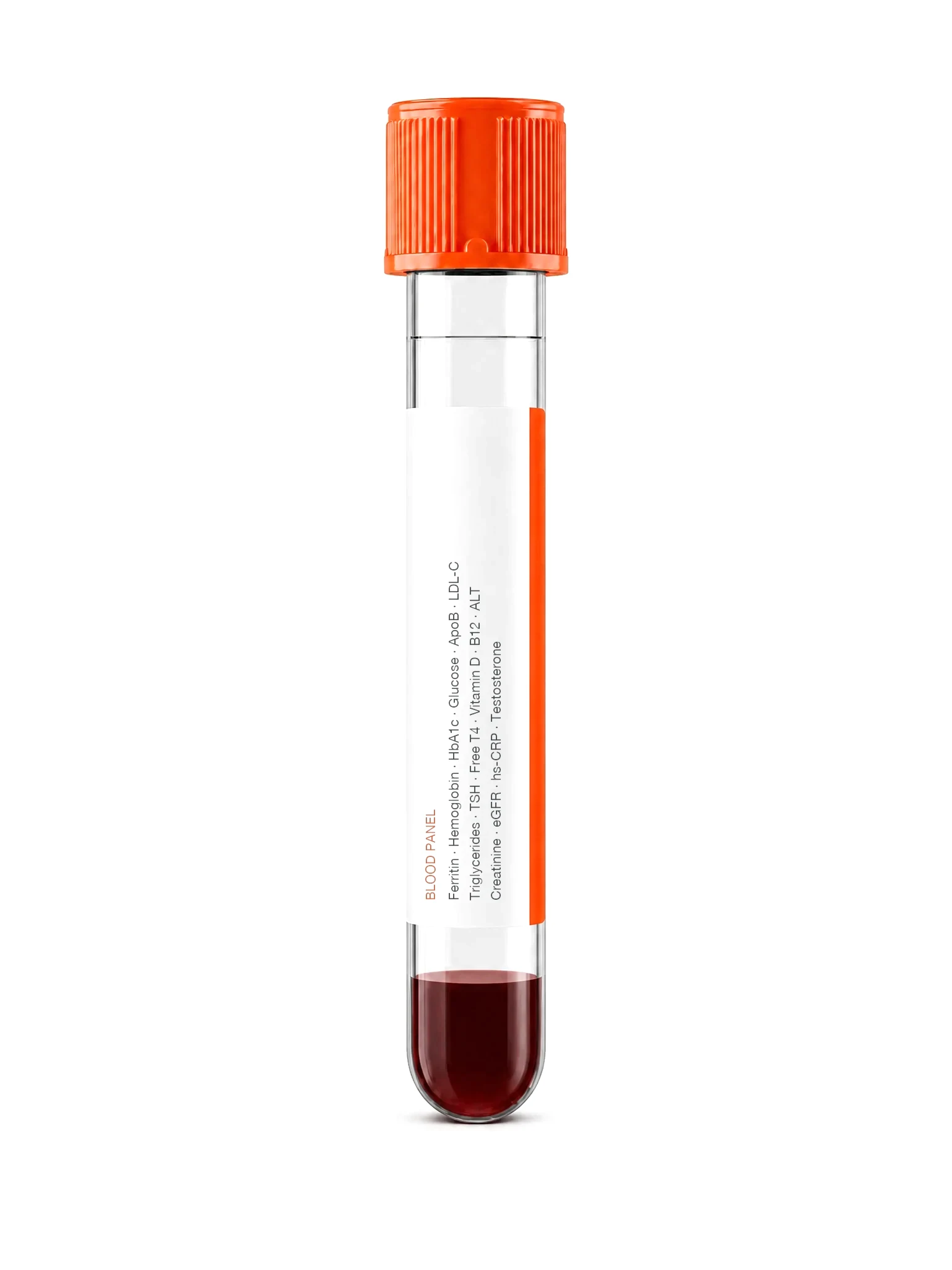
Markers your isotretinoin blood tests read
What your results mean while you're on isotretinoin
Triglycerides are the result most likely to move on isotretinoin. Among people who started with normal values, Zane's cohort found new abnormalities in 44% for triglycerides, 31% for total cholesterol and 11% for liver enzymes, and the moderate and severe changes were generally transient and reversible 3. The original trials reported marked triglyceride rises in about 25% of patients, a fall in HDL cholesterol in about 15% and a rise in total cholesterol in about 7%, reversing after the drug stopped 5.
Example: a triglyceride result 2 months into isotretinoinmg/dL
| Marker | Typical change on isotretinoin | When it matters | What usually happens |
|---|---|---|---|
| Triglycerides | Up in 44% of people with a normal start 3 | A level that keeps climbing toward 500 mg/dL, or tummy pain spreading to the back | A mild rise means a recheck, and often less alcohol and fatty food; a higher rise may mean a lower dose. The label says stop if the level cannot be controlled or pancreatitis symptoms appear 5 |
| Total and LDL cholesterol | Total up in 31% in Zane 3, about 7% in the trials 5 | Rarely, over a course of a few months | Recheck; usually returns to baseline after the course 5 |
| HDL cholesterol | Down in about 15% 5 | Rarely on its own | Usually returns after the course 5 |
| ALT and AST | Up in 11% 3; mild to moderate rises in about 15% in the trials 5 | A rise that stays up on recheck, or signs of hepatitis such as yellow skin | Some settle with a lower dose or with time; if not, the label says stop 5. Ask when the recheck is due and what level would change your dose; if ALT stays high after the course, our fatty liver page covers the other common cause |
Lab reports outside the US often give triglycerides in mmol/L: 150 mg/dL is about 1.7 mmol/L and 500 mg/dL is about 5.6 mmol/L. Our guide to lab units explains why the numbers differ. The lipid panel guide, liver enzymes guide and cholesterol vs triglycerides explain what each line measures, and the AST to ALT ratio helps when AST rises alone after exercise.
 CalculatorCholesterol converterTurns a triglyceride or cholesterol result between mg/dL and mmol/LWork it out
Cholesterol lines that shift on isotretinoin
Side effects of isotretinoin, from most to least common
Most isotretinoin side effects come from dryness, and most ease with a lower dose and go once the course ends. In Blasiak's study almost every patient had dry lips (cheilitis) and dry skin 6.
| Side effect | How common | What helps |
|---|---|---|
| Dry, cracked lips | Almost everyone 6 | Lip balm many times a day |
| Dry skin, eczema-like patches | Almost everyone 6 | Fragrance-free moisturizer and a gentle cleanser |
| Dry eyes, contact lenses harder to wear | Common 5 | Lubricating eye drops; glasses for part of the day |
| Nosebleeds | Common 5 | Petroleum jelly inside the nostrils; a humidifier |
| Sunburn more easily | Common 5 | SPF 30 or higher, shade, no sunbeds |
| Muscle and joint aches | About 16% in one trial; back pain in 29% of teenagers 5 | Ease off very hard new training; tell your prescriber if severe; see joint pain for other causes |
| CK rise after hard exercise | 12% of teenagers in one trial 5 | Tell the lab and prescriber about recent workouts |
| Hair thinning | Uncommon | Usually regrows after the course, and in some cases persists 5; see hair loss |
| Poorer night vision | Rare 5 | Take care driving at night and report it |
Isotretinoin and mood: what the largest analysis shows
The FDA label warns that isotretinoin may cause depression, psychosis and, rarely, suicidal thoughts and suicide attempts 5. The largest pooled data do not show a raised risk across the population. In JAMA Dermatology in 2024, Tan and colleagues reviewed 25 studies covering about 1.6 million people and pooled 24 of them 4. One year on, 3.83% of users had depression, and completed suicide, suicide attempts, suicidal thoughts and self-harm were each under 0.5%. Users were also less likely than non-users to attempt suicide 2 to 4 years after treatment 4. Population figures cannot rule out a rare person whose low mood tracks the drug; our page on mood swings covers other causes worth checking.
The findings suggest that at a population level, isotretinoin users do not have increased risk of suicide or psychiatric conditions but may instead have a lower risk of suicide attempts at 2 to 4 years following treatment.Tan NKW et al., JAMA Dermatology, 2024 4
Pregnancy, contraception and iPLEDGE
There is an extremely high risk that severe birth defects will result if pregnancy occurs while taking Accutane in any amount, even for short periods of time.
Isotretinoin is one of the strongest known causes of birth defects. The label lists defects of the skull, face, eyes, ears, brain, heart, and thymus and parathyroid glands, a raised risk of miscarriage and premature birth, and cases of IQ below 85 5. In the US, everyone who takes isotretinoin is enrolled in iPLEDGE, an FDA-required safety program that was updated on 15 November 2026 10; the exact steps come from your prescriber and the program. For anyone who can get pregnant, they include 5 10:
- Use two forms of contraception together, at least one of them a primary form such as an IUD, implant or combined pill, or commit to abstinence, from 1 month before the first dose.
- Have two negative pregnancy tests in a clinic or lab before the first prescription.
- Have a pregnancy test within 7 days before each prescription, which covers no more than 30 days; once treatment has started, your prescriber may allow these to be home tests.
- Keep both forms of contraception through the course and for 1 month after the last dose.
- Have a pregnancy test at the end of treatment and another 1 month later.
The 1-month rule after the last dose is the label's requirement, and it should not be shortened: keep contraception going until then, take the final test, and talk to your prescriber before trying to conceive 5. Our fertility page covers the tests worth reading before trying. People who cannot get pregnant, including men, are enrolled too but need no pregnancy tests; in a study of 50 men on isotretinoin, sperm count, movement and shape were not affected 5. The rule for everyone is never to share capsules. Nobody on isotretinoin may donate blood during the course or for 1 month after, in case the blood goes to a pregnant patient 5. The pregnancy test itself is explained on our beta-hCG page, and birth control and blood tests covers what the pill does change on a lab report.
What to avoid on isotretinoin
| Avoid | Why |
|---|---|
| Vitamin A supplements, high-dose multivitamins and beef liver capsules | Isotretinoin is a vitamin A relative, and the label says not to take vitamin A supplements with it 5. This is about the vitamin A in supplements; the vitamin A blood test is not part of routine monitoring. |
| Tetracycline antibiotics (doxycycline, minocycline) | Both drugs can raise pressure around the brain; the label says to avoid the combination 5 |
| Heavy drinking | The label names heavy drinking as a risk factor for high triglycerides on isotretinoin, and cutting alcohol is one way a raised level comes back down 5 |
| Waxing, laser resurfacing and dermabrasion | Risk of scarring; avoid during the course and for at least 6 months after 5 |
| St John's wort | May make hormonal birth control less reliable 7 |
| Progestin-only minipills as the main contraception | The label does not count them as an adequate form on isotretinoin 5 |
| Sunbeds and long sun exposure | Skin burns more easily on isotretinoin 5 |
| Blood donation | Not during the course or for 1 month after 5 |
Our guide to supplements that affect blood tests lists other products worth pausing before a monitoring draw.

Citations
- Reynolds RV, Yeung H, Cheng CE, et al. Guidelines of care for the management of acne vulgaris. J Am Acad Dermatol. 2024;90(5):1006.e1-1006.e30.
- Huang CY, Chang IJ, Bolick N, et al. Comparative efficacy of pharmacological treatments for acne vulgaris: a network meta-analysis of 221 randomized controlled trials. Ann Fam Med. 2023;21(4):358-369.
- Zane LT, Leyden WA, Marqueling AL, Manos MM. A population-based analysis of laboratory abnormalities during isotretinoin therapy for acne vulgaris. Arch Dermatol. 2006;142(8):1016-1022.
- Tan NKW, Tang A, MacAlevey NCYL, Tan BKJ, Oon HH. Risk of suicide and psychiatric disorders among isotretinoin users: a meta-analysis. JAMA Dermatol. 2024;160(1):54-62.
- Absorica and Absorica LD (isotretinoin capsules) US prescribing information and medication guide. Sun Pharmaceutical Industries; DailyMed, US National Library of Medicine, label version of August 2026.
- Blasiak RC, Stamey CR, Burkhart CN, Lugo-Somolinos A, Morrell DS. High-dose isotretinoin treatment and the rate of retrial, relapse, and adverse effects in patients with acne vulgaris. JAMA Dermatol. 2013;149(12):1392-1398.
- Accutane (isotretinoin capsules) original US prescribing information, including boxed warning and clinical pharmacology. Roche; US Food and Drug Administration label, 2008.
- Lee YH, Scharnitz TP, Muscat J, et al. Laboratory monitoring during isotretinoin therapy for acne: a systematic review and meta-analysis. JAMA Dermatol. 2016;152(1):35-44.
- National Cholesterol Education Program (NCEP) Expert Panel on Detection, Evaluation, and Treatment of High Blood Cholesterol in Adults. Third Report of the NCEP Expert Panel (Adult Treatment Panel III) final report. Circulation. 2002;106(25):3143-3421.
- US Food and Drug Administration. iPLEDGE Risk Evaluation and Mitigation Strategy (REMS), including the modifications implemented 15 November 2026.
Educational context only, not medical advice or a diagnosis. Always discuss your results with a clinician.