Plain chamomile has a mild, floral flavor. In a bedtime blend, the other ingredients matter. Two boxes can show chamomile flowers on the front, but a blend that also lists regular green tea contains caffeine. 13 The research leaves open which brewed tea works best. Someone who gives their sleep a better rating in the morning may still have spent the same amount of time waiting to fall asleep. 13
Seven bedtime teas and what people noticed
The plant name on a box tells you only part of the story. Researchers have tested flowers steeped in water, drinks made with powdered flowers and capsules containing concentrated root extract. Here’s what people used and what they noticed, alongside the ingredients to look for when you shop.
| Herb | Taste or label cue | What to know before you choose |
|---|---|---|
| Chamomile | Mild, floral flowers, sometimes with an apple-like scent. | After two weeks, new mothers who drank brewed chamomile said physical discomfort interfered less with sleep. 2 Adults with insomnia reported falling asleep sooner with chamomile powder tea than with passionflower powder tea. 1 |
| Passionflower | A mild, grassy herb. Look for passionflower or Passiflora incarnata. Passion fruit flavor is a different ingredient. | Healthy young adults rated their sleep better during a week of brewed passionflower. 3 Avoid passionflower during pregnancy because it may trigger uterine contractions. Little is known about its safety while breastfeeding. 7 |
| Valerian | An earthy root with a pungent smell. It can be easy to miss in a minty blend. | US guidance advises against valerian for chronic insomnia. 6 Avoid combining valerian with alcohol or medicines that make you sleepy. 8 |
| Lavender | A pronounced floral scent, even when lavender is one ingredient in a blend. | Chen and Chen asked women who had recently given birth to smell lavender tea before drinking it. After two weeks, they reported less fatigue than the usual-care group, with no clear advantage in sleep quality. 9 |
| Lemon balm | A lemon-scented leaf. Lemon peel and lemongrass are different ingredients. | In Taavoni and colleagues’ study after menopause, sleep scores improved more with capsules containing both lemon balm and valerian than with placebo. The study leaves the effect of plain lemon balm tea uncertain. 10 |
| Magnolia | Look for the plant part, such as bark or flowers. | A study after childbirth found a lower average score for sleep problems linked to physical symptoms at week three. An inconsistency in the published statistics makes the difference uncertain. The paper doesn’t specify which plant part went into the tea. 4 |
| Ashwagandha | Check whether the product contains root or root extract. | Langade and colleagues found that adults with insomnia fell asleep sooner with capsules of root extract than with placebo. A tea bag makes a different preparation. 11 Avoid ashwagandha during pregnancy and breastfeeding. 12 |
For loose chamomile flowers, follow the packet’s steeping directions and strain out the flowers when the flavor suits you. For a valerian root or magnolia bark product, check its own directions for heating and straining. A tea bag containing finely cut root may call for a different preparation from loose pieces of bark. Adjust the next brew for taste. A stronger smell or darker cup tells you little about what will happen when you turn out the light.
Does chamomile help you fall asleep faster?
Chamomile and passionflower, compared by what people drank
Khalid and colleagues studied adults aged 25 to 45 with insomnia. The study plan lists green tea for the comparison group. The authors report the average time each group took to fall asleep, but give no starting averages for that measure. That makes it hard to tell how much anyone improved. The study also leaves open whether an ordinary tea bag would give similar results. 1
What changed for new mothers drinking chamomile?
Chang and Chen studied 80 women in Taiwan who were sleeping poorly after giving birth. Their questionnaire asked how physical symptoms affected sleep. For a new parent, there’s a difference between lying awake because your body feels uncomfortable and waking because your baby needs you. The finding at two weeks concerned the first problem. By the four-week assessment, women who had received usual care scored similarly to the tea drinkers on all three questionnaires. 2
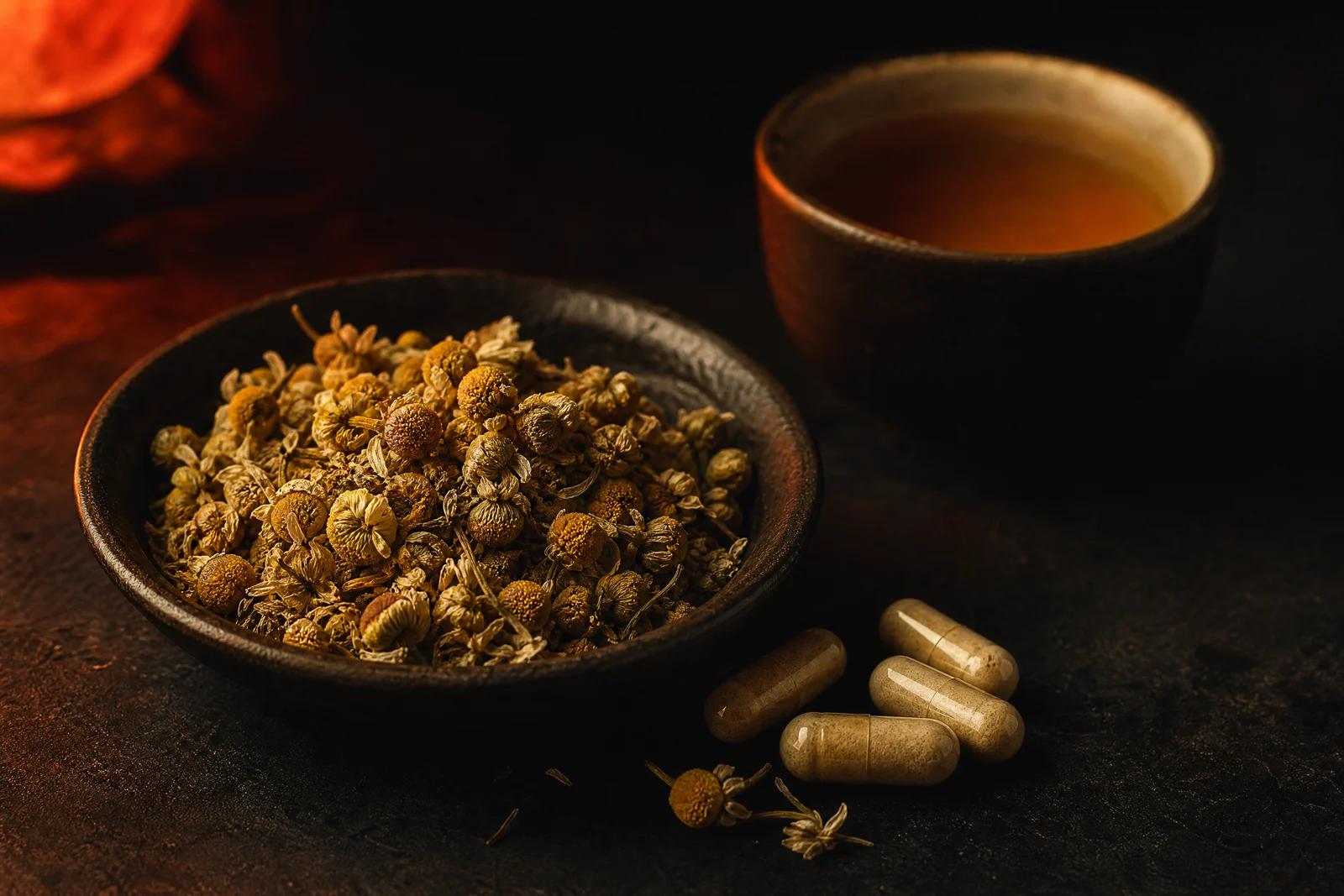
Chamomile flowers contain a plant compound called apigenin. 17 If you’re looking at apigenin capsules, neither chamomile study can tell you how much of the result came from that one ingredient. Participants drank preparations made from the flowers. 12
Apigenin in chamomile
What did people notice with brewed passionflower?
Ngan and Conduit recruited 41 healthy adults aged 18 to 35. Each person drank passionflower tea for one week and a comparison tea for another, with a week off between them. Some tried passionflower first and others tried it second. That design let researchers compare each person’s diary during the two weeks without telling them which tea they were drinking. 3
Overall sleep quality was the only one of six diary measures that clearly favored passionflower. Ten volunteers also had overnight sleep recordings. The small recording study leaves open whether the tea changes time spent in deep sleep, the stage identified by slow brain waves. If your main difficulty is the hour you spend awake before drifting off, the diary finding gives you little guidance about that hour. 3
Is valerian the strongest sleep tea?
Valerian may be the strongest-smelling tea on the shelf. Its earthy smell comes from the root. A blend with peppermint or lavender can taste quite different, so it pays to scan the full ingredient list even if the box says “mint.” There’s no good basis for ranking valerian the most effective sleep tea. The 2025 insomnia guideline from the US Departments of Veterans Affairs and Defense gives a weak recommendation against using valerian, chamomile or passionflower to treat chronic insomnia. The panel had very little confidence in the evidence behind these remedies. 6
Valerian can cause mental dullness. The National Center for Complementary and Integrative Health advises against combining it with alcohol or sedating medicines, including sleeping pills. A pharmacist can check a blend against the medicines someone takes. 8
Valerian root in sleep blends

What about magnolia, lavender, lemon balm or ashwagandha?
Magnolia has a study of the drink itself. Xue and colleagues assigned 112 women after childbirth to magnolia tea or usual care. The researchers followed up after the tea period ended. At week three, 52 women in the tea group and 51 in the usual-care group returned questionnaires. Their answers show how the two groups compared over time, although the paper’s week-three significance test doesn’t match the figures in its table. 4
Of the other preparations, lavender is the easiest to recognize in a kitchen. The participants paused to smell the tea before drinking it, so the experiment leaves the effects of the aroma and the drink together. 9 If you enjoy lemon balm’s citrus taste, you can choose it on that basis. The combination capsule gives no way to tell how much lemon balm contributed on its own. 10 The same shopping question comes up with ashwagandha. A trial of a concentrated extract offers little guidance about what to expect from root steeped in water. 11
How to spot caffeine in a bedtime blend
A moon on the box tells you when the maker thinks you might enjoy the blend. The ingredient list tells you more about what you’ll drink. Chin and colleagues brewed 20 commercial tea products and measured the caffeine. The caffeine amounts overlapped across white, green and black teas. Steeping time affected the amount in the cup, and the decaf teas still contained some caffeine. The team detected none in the herbal varieties they tested. 13
| If the ingredient list says | What’s in your cup |
|---|---|
| Chamomile flowers | A naturally caffeine-free herbal tea. A single ingredient also makes it easy to remember what you drank. 513 |
| Green tea, chamomile flowers, lemon peel | A caffeinated green tea with a floral, citrus flavor. Adding flowers and peel leaves the caffeine in the blend. 13 |
| Decaffeinated black tea, vanilla flavor | Black tea with most of its caffeine removed. Decaf can still contain a little caffeine. 13 |
Matcha is powdered green tea. Other caffeine clues on the label include oolong, pu-erh and yerba mate. A blend can smell like mint or taste like peach and still have a caffeinated base. Green tea also contains L-theanine, an amino acid in tea leaves. Its presence doesn’t make the drink caffeine-free.
The amount of caffeine and the time you drink it both matter. In a trial of 23 men, a larger amount of caffeine disrupted sleep even when the men took it earlier in the day. The overnight recordings picked up changes that the men themselves did not always notice. 14 A sleep diary can include afternoon coffee as well as evening tea.
When to drink bedtime tea
Choose a time when you can enjoy the tea without waking later for an extra bathroom trip. The chamomile and passionflower studies give no dependable countdown from the last sip to falling asleep. 123 If you usually read after dinner, that can be a convenient time for tea. If you still wake often to pee after moving your drink earlier, tell your clinician whether the urge woke you or you went because you were already awake. The guide to frequent urination at night explains what they may check.
Honey sweetens the drink. The brewed-tea trials did not compare sweetened tea with unsweetened tea, so they cannot tell us whether adding honey makes a difference to sleep. 23
A sleep diary you can keep in one line
Record the blend, your last caffeinated drink, bedtime, what woke you and how you felt in the morning. Pick one detail that matters most to you. If you lie awake at bedtime, estimate how long it took to drift off. If your main difficulty is waking in the night, note what woke you and whether you could get back to sleep.
After several nights, check whether you took longer to fall asleep on days you worked late or drank coffee on the way home. A diary can reveal that your alarm stayed fixed while bedtime slipped later throughout the week. That pattern gives you a more specific conversation to have with a clinician than the name of the tea you tried.
 CalculatorSleep calculatorIf your wake-up time is fixed, work backward to a possible bedtime and compare it with the time in your diary.Work it out
When trouble sleeping deserves a closer look
If trouble falling or staying asleep keeps affecting your concentration, mood or energy, bring it up with a clinician. Chronic insomnia typically means difficulty sleeping at least three nights a week for at least three months, despite enough opportunity to sleep, with effects during the day. You can ask for help sooner. 6 When you describe a typical night, mention whether you have trouble falling asleep, wake repeatedly or wake for the day much earlier than planned.
Ask about cognitive behavioral therapy for insomnia, or CBT-I. The VA/DoD guideline recommends it for chronic insomnia. In a structured program, you work on the habits and thoughts that keep you awake, including what happens when bed becomes the place where you spend hours worrying about sleep. A diary gives you and your clinician somewhere concrete to start. 6
If you’re comparing other evening drinks, only eight people completed one pilot study of tart cherry juice for insomnia. 18 For help making enough time for sleep around a fixed work or school schedule, see the sleep guides.
Turning your results into a plan
One number says where you stand today. A plan says what you'll change, food, movement, sleep, and what to ask your doctor, and a retest shows whether it worked. Add your report and LifeFrom reads every marker on it, then builds the steps with you.

- 01Read it. Every marker on your report in plain words, against your lab's range and the guideline.
- 02Plan it. Turn it into steps you choose: food, movement, sleep, and what to ask your doctor.
- 03See it working. Retest, and LifeFrom puts both results side by side.
- 01Time to fall asleep and overall sleep quality are different outcomes
Adults with insomnia reported falling asleep sooner with chamomile powder tea than with passionflower powder tea. 1 In a separate trial, healthy adults gave brewed passionflower better overall sleep ratings than placebo. That rating tells us how they judged their nights, without establishing how quickly they fell asleep. 3
Citations
- Khalid Z and colleagues. Comparative effect of Chamomile flower (Matricaria chamomilla L.) and Passion flower (Passiflora incarnata L.) powder tea in patients suffering from primary insomnia. CyTA - Journal of Food. 2025. Tables 1 and 3.
- Chang SM, Chen CH. Effects of an intervention with drinking chamomile tea on sleep quality and depression in sleep disturbed postnatal women: a randomized controlled trial. Journal of Advanced Nursing. 2016.
- Ngan A, Conduit R. A double-blind, placebo-controlled investigation of the effects of Passiflora incarnata (passionflower) herbal tea on subjective sleep quality. Phytotherapy Research. 2011.
- Xue L and colleagues. A randomized controlled pilot study of the effectiveness of magnolia tea on alleviating depression in postnatal women. Food Science & Nutrition. 2020. Table 2.
- National Center for Complementary and Integrative Health. Chamomile. Safety, plant allergies and medication interactions.
- US Departments of Veterans Affairs and Defense. VA/DoD Clinical Practice Guideline for the Management of Chronic Insomnia Disorder and Obstructive Sleep Apnea. 2025. Recommendations 5 and 14.
- National Center for Complementary and Integrative Health. Passionflower. Safety during pregnancy and breastfeeding.
- National Center for Complementary and Integrative Health. Valerian. Side effects and cautions about alcohol and sedatives.
- Chen SL, Chen CH. Effects of lavender tea on fatigue, depression, and maternal-infant attachment in sleep-disturbed postnatal women. Worldviews on Evidence-Based Nursing. 2015.
- Taavoni S, Nazem Ekbatani N, Haghani H. Valerian/lemon balm use for sleep disorders during menopause. Complementary Therapies in Clinical Practice. 2013.
- Langade D and colleagues. Efficacy and Safety of Ashwagandha (Withania somnifera) Root Extract in Insomnia and Anxiety: A Double-blind, Randomized, Placebo-controlled Study. Cureus. 2019.
- National Center for Complementary and Integrative Health. Ashwagandha. Safety during pregnancy and breastfeeding.
- Chin JM and colleagues. Caffeine content of brewed teas. Journal of Analytical Toxicology. 2008.
- Gardiner C and colleagues. Dose and timing effects of caffeine on subsequent sleep: a randomized clinical crossover trial. Sleep. 2025.
- MedlinePlus Medical Encyclopedia. Anaphylaxis. Symptoms and when to call for emergency help.
- National Highway Traffic Safety Administration. Drowsy driving. What to do when you feel sleepy behind the wheel.
- Redaelli C, Formentini L, Santaniello E. Reversed-phase high-performance liquid chromatography analysis of apigenin and its glucosides in flowers of Matricaria chamomilla and chamomile extracts. Planta Medica. 1981.
- Losso JN and colleagues. Pilot Study of the Tart Cherry Juice for the Treatment of Insomnia and Investigation of Mechanisms. American Journal of Therapeutics. 2018.
Educational context only, not medical advice or a diagnosis. Always discuss your results with a clinician.