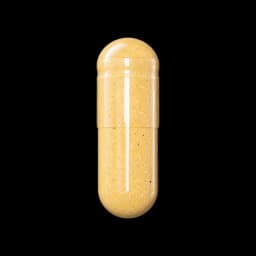
SupplementsFatty AcidsVegan Omega
Vegan Omega
algae oil with DHA and EPA
Fish don't make most of their omega-3 from scratch. It comes up the food chain from algae, and this softgel simply skips the fish.

- Builds up
- Weeks to months
- In your body
- Weeks
- Per 1 softgel
- 7 ingredients
- 30-day supply
- $10.80One capsule a day, plus packing and delivery
What is vegan omega?
EPA and DHA are the omega-3 fats your cells build into their walls, with DHA important for developing brains and eyes. People usually think of them as coming from fish, but in the water they start in algae. Fish build up high levels by eating what ate the algae.
This softgel goes straight to the source. It's 500 mg of algae oil, holding 275 mg of total omega-3, with 150 mg of DHA and 75 mg of EPA. It's certified vegan, with a plant-based shell made from starch, glycerin and carrageenan, a seaweed extract.
If you don't eat fish, this is the part that matters. Plant foods like flax give you a different omega-3 called ALA, and your body turns almost none of that into DHA.
What it does
- Plant-based nutritionProvides EPA and DHA without any fish.
- Brain and eyesDHA supports normal brain and eye function.
- TriglyceridesHelps maintain triglycerides already in the healthy range.
- HeartSupports normal heart function.
These statements have not been evaluated by the FDA. This product is not intended to diagnose, treat, cure or prevent any disease.
What people take it for
 Some evidenceFilling a plant-based gapIn a study of vegans who started low, a similar algae supplement raised their omega-3 index from 3.1% to 4.8% in 4 months.
 Early daysTriglyceridesAlgae DHA looks comparable to fish oil for lowering triglycerides. Medical advice for high triglycerides uses far more than one softgel.
 Early daysPregnancy and planningEPA and DHA matter for a developing baby's brain, eyes and immune system. Most of the research used fish oil or a mix, so ask your doctor what fits.
How long it takes
It builds slowly, the same way fish oil does. In vegans who started low, the omega-3 index rose over 4 months. Your red blood cells keep adjusting for around 6 months.
- DaysStarts showing up in the fats in your blood
- 2 weeksAt 600 mg of DHA a day, blood DHA rose as much as with cooked salmon
- 4 monthsOmega-3 index rose from 3.1% to 4.8% in vegans
How long it stays in your body
There's no quick half-life, because these fats become part of your cells. Fish oil studies, which used the same fats, show levels easing off over weeks after people stop. We found no separate number for algae.
What's in a capsule
One softgel holds 225 mg of EPA and DHA combined. The vegan study used 254 mg a day, so one softgel is close to that. Medical advice for high triglycerides uses 2 to 4 g a day, far more than this.
Why flax isn't the same, and how algae compares
The obvious plant-based answer is flax or chia, and they're good foods. But they hold ALA, which your body must convert. Some becomes EPA, and almost none becomes DHA. Even high amounts of flax oil failed to raise the omega-3 index in studies, while algae oil raised it in every study reviewed.
Does it match fish? For DHA, it seems so. In a head-to-head test over 2 weeks, algae capsules and cooked salmon raised blood DHA by the same amount. And vegans aren't as far behind as you might think: they averaged 3.7%, about the same as people who eat meat but rarely eat fish. Fish can also pick up pollutants on the way up the food chain, a step this skips.
The mix is different, though. Ours has twice as much DHA as EPA, where our fish oil has more EPA than DHA. In studies, DHA raised LDL cholesterol a bit more than EPA did, so check your LDL along with your triglycerides.
What it interacts with
- Warfarin and other blood thinnersThese are the same fats as fish oil, which has raised INR in a reported case, though large reviews found no more bleeding overall. Get your INR checked.
- Heart rhythm problemsFish oil studies link omega-3 with a higher risk of atrial fibrillation, mostly at larger amounts than this. Talk to your doctor if you've had it.
- Cholesterol medicinesDHA can nudge LDL up, so mention it when your cholesterol is reviewed.
- DiabetesIn studies using fish oil, omega-3 didn't change blood sugar or HbA1c.
- Blood pressure medicinesOmega-3 can lower blood pressure slightly in fish oil studies, so mention it if you take these.
Goes well with
Side effects
- We found little that's specific to algae oil. For omega-3 supplements in general, effects are usually mild: an unpleasant taste, bad breath, headache, heartburn, nausea or diarrhea.
- A slightly higher chance of atrial fibrillation has been seen with fish oil, mainly at larger amounts. See your doctor if your heart flutters or races.
Check first if
- Blood thinners: talk to your doctor and keep an eye on your INR.
- Bleeding disorder or surgery coming up: tell your doctor, since these are the same fats as fish oil.
- Atrial fibrillation or other rhythm problems: talk to your doctor first.
- Pregnancy or breastfeeding: ask your doctor how much omega-3 suits you.
- Sensitive to carrageenan: the softgel shell contains it.
The blood tests that go with it
- TriglyceridesThe number omega-3 moves most reliably.
- LDL cholesterolDHA can nudge this up, and this softgel leans toward DHA.
- HDL cholesterolDHA can nudge this up too.
- Triglyceride to HDL ratioCombines the two numbers in one read.
- Non-HDL cholesterolA good overall view of the cholesterol that matters.
- INRWorth checking if you take warfarin.
- Heart rhythmThe thing to keep an eye on, since omega-3 is tied to atrial fibrillation at larger amounts.
Work it out

Supplementation
Find Vegan Omega in a ready-made protocol.
Start from one of these, or add it to your own. Everything comes in one pouch each morning.
Daily foundations
For a plant-based routine.
30-day pack · 7 a morning · 210 pills
$86.10 / month
Choose this packYour own
Build your own pouch.
Know what you want to take? Pick each ingredient, and we time it through your day.
Build your own




- cGMP-certifiedFacilities
- FDA-registeredFacilities
- Accredited labsIndependent testing
- Non-GMOIngredient options
- OrganicIngredient options
- VeganFormula options
These statements have not been evaluated by the Food and Drug Administration. These products are not intended to diagnose, treat, cure or prevent any disease.
Want it more precise? Get the app.
A page can only tell you about Vegan Omega. The app tells you about you: whether it fits, when to take it, and whether it's working.
- Checked against your blood work and everything you already take
- On your daily timeline, around your sleep, training and meals
- Followed over time, so you can see what moved

 Vegan OmegaOPEN 09:00
Vegan Omega against your blood work, your sleep and what you already take.
 AI
You've been plant-based for 3 years, and your last omega-3 test was low. Worth retesting after a few months on algae?
ASK ABOUT VEGAN OMEGAFind the goal that's yours.
Your record, your routine and LifeFrom AI, pointed at the outcome that matters to you.



Questions
What is algae omega-3 good for?
It gives you EPA and DHA without fish, which matters most on a vegan or vegetarian diet. It also supports healthy triglycerides, along with your brain and eyes.
Is algae omega-3 as good as fish oil?
For DHA, it looks like it. Algae capsules and cooked salmon raised blood DHA by the same amount in a 2-week test. Fish oil has much more research on heart health, and this softgel holds less per capsule than our fish oil.
How long does algae omega-3 take to work?
It's slow. In vegans, the omega-3 index rose over 4 months. Give it a few months before you retest.
What are the side effects of algae omega-3?
We found little specific to algae. For omega-3 supplements in general, they're usually mild, like an unpleasant taste, heartburn or nausea.
What does algae omega-3 interact with?
Think of it like fish oil. Blood thinners like warfarin are the main one to mention to your doctor.
Who should not take algae omega-3?
Check first if you take blood thinners, have had atrial fibrillation, or are pregnant or breastfeeding. It's free of fish, so a fish allergy isn't the issue here.
Can I take algae omega-3 every day?
Yes, that's how it was used in studies, including 4 months in vegans. There's less long-term research than for fish oil.
Can't I just eat flax or chia?
They're good foods, but your body turns almost none of their omega-3 into DHA. High amounts of flax oil didn't raise the omega-3 index in studies, while algae oil did.
What is the half-life of algae omega-3?
There's no one number, because the fats become part of your cells. Studies with fish oil suggest they ease off over weeks after you stop.
Do vegans really need it?
Not everyone, but it's worth checking. Vegans in one study averaged an omega-3 index of 3.7%, which counts as low. A blood test can tell you where you stand.
Sources
- NIH National Center for Complementary and Integrative Health. Omega-3 supplements: what you need to know.
- Sarter B et al. Blood docosahexaenoic acid and eicosapentaenoic acid in vegans. Clin Nutr, 2015.
- Arterburn LM et al. Algal-oil capsules and cooked salmon: nutritionally equivalent sources of docosahexaenoic acid. J Am Diet Assoc, 2008.
- Lane KE et al. Bioavailability and conversion of plant based sources of omega-3 fatty acids. Crit Rev Food Sci Nutr, 2022.
- Doughman SD et al. Omega-3 fatty acids for nutrition and medicine: considering microalgae oil as a vegetarian source of EPA and DHA. Curr Diabetes Rev, 2007.
- Brenna JT et al. Alpha-linolenic acid supplementation and conversion to n-3 long-chain polyunsaturated fatty acids in humans. Prostaglandins Leukot Essent Fatty Acids, 2009.
- Swanson D et al. Omega-3 fatty acids EPA and DHA: health benefits throughout life. Adv Nutr, 2012.
- Katan MB et al. Kinetics of the incorporation of dietary fatty acids into serum cholesteryl esters, erythrocyte membranes, and adipose tissue. J Lipid Res, 1997.
- Cao J et al. Incorporation and clearance of omega-3 fatty acids in erythrocyte membranes and plasma phospholipids. Clin Chem, 2006.
- Wei MY, Jacobson TA. Effects of eicosapentaenoic acid versus docosahexaenoic acid on serum lipids. Curr Atheroscler Rep, 2011.
- Skulas-Ray AC et al. Omega-3 fatty acids for the management of hypertriglyceridemia. Circulation, 2019.
- Gencer B et al. Effect of long-term marine omega-3 fatty acids supplementation on the risk of atrial fibrillation. Circulation, 2021.
- Javaid M et al. Bleeding risk in patients receiving omega-3 polyunsaturated fatty acids. J Am Heart Assoc, 2024.
- Buckley MS et al. Fish oil interaction with warfarin. Ann Pharmacother, 2004.
- Hartweg J et al. Omega-3 polyunsaturated fatty acids for type 2 diabetes mellitus. Cochrane Database Syst Rev, 2008.
- Duarte Batista L et al. Association of two cut-off points for the n-3 index with cardiometabolic risk factors. Br J Nutr, 2025.
- Miller PE et al. Long-chain omega-3 fatty acids and blood pressure. Am J Hypertens, 2014.
Written by LifeFrom from these sources, and not yet reviewed by a clinician. Talk to your doctor before starting a supplement.