Practice lab reports for AI
4,000 invented lab reports in the conventions of 6 countries, each as a PDF, a scanned page and a phone photo, with the right answer for every one of their 165,538 printed results. Use them to measure how well software and AI read lab reports, or to train it, without touching real patient data.
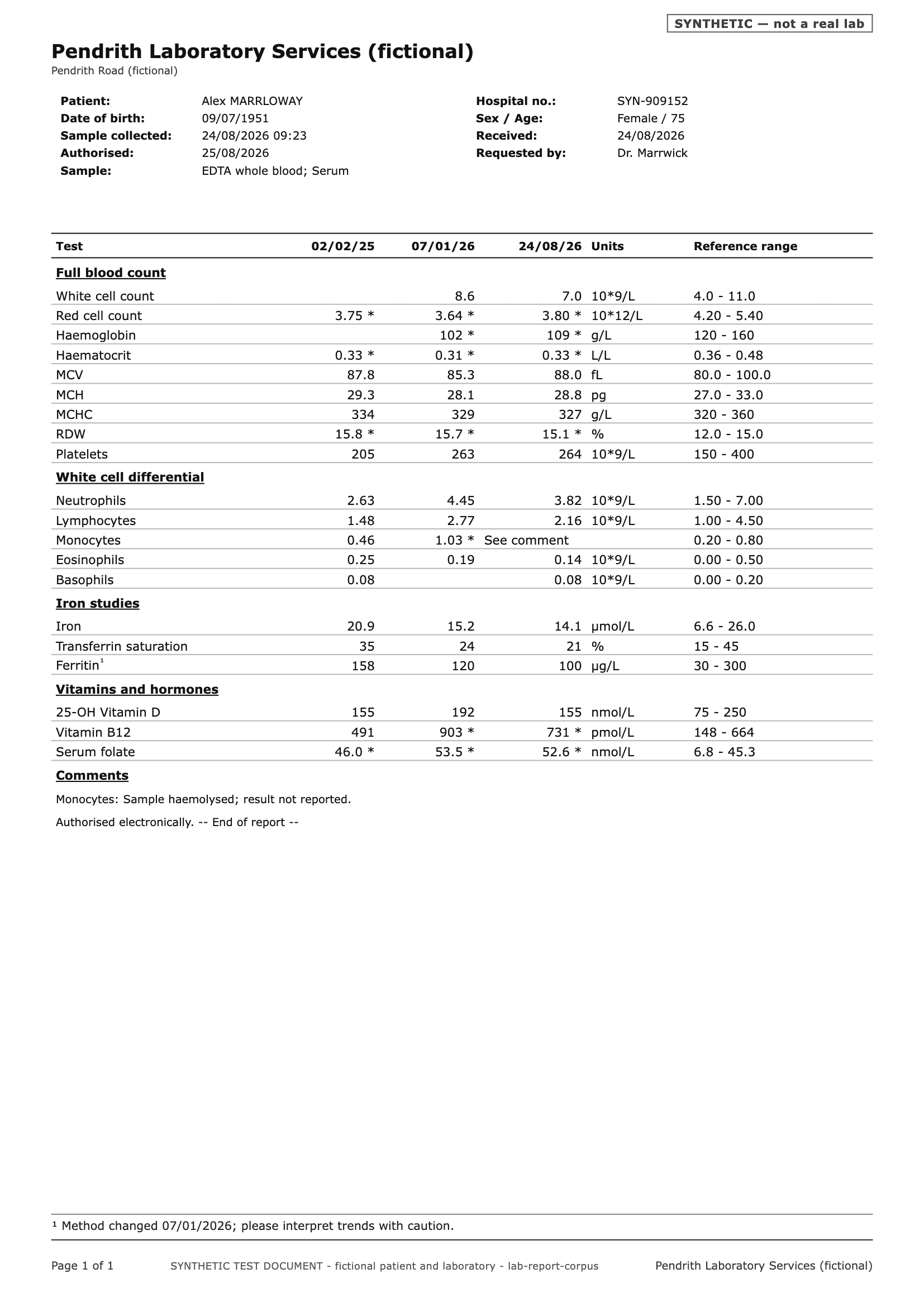
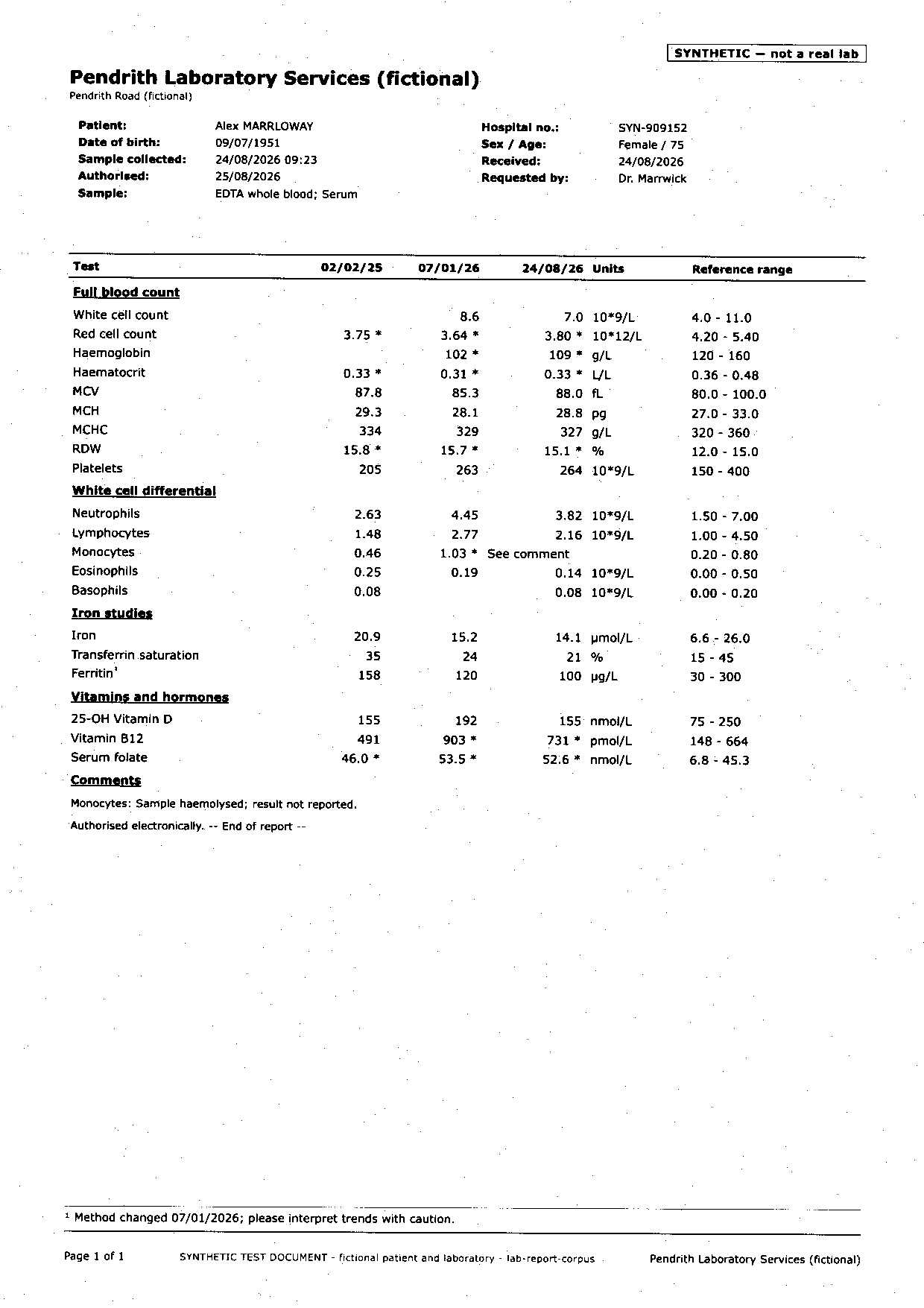
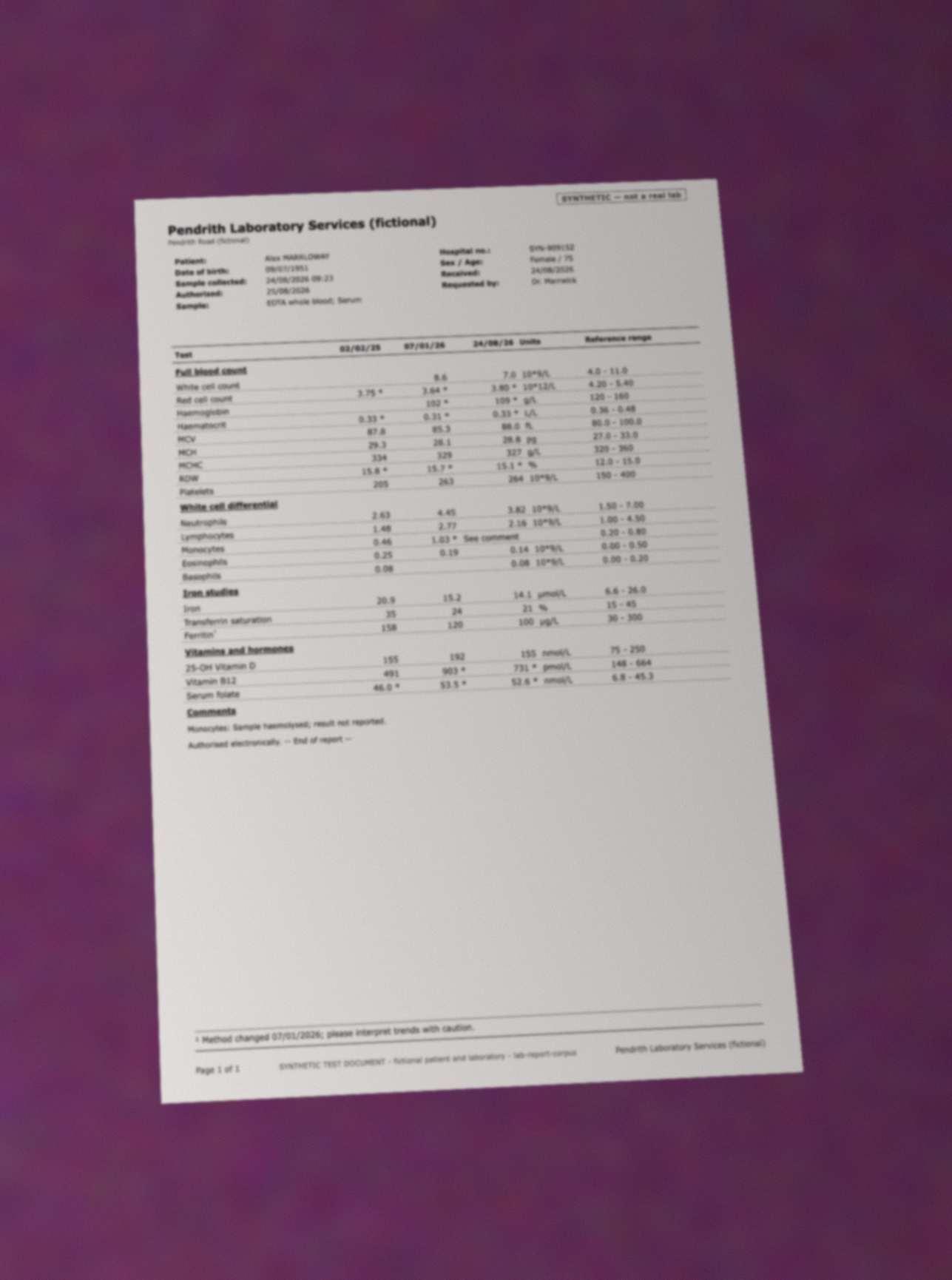
- Reports
- 4,000
- Pictures
- 6,371
- Results with answers
- 165,538
- Markers
- 60
Countries and layouts
Germany 699 · United States 695 · Romania 689 · Spain 673 · France 652 · United Kingdom 592. 14 page layouts, including reports with earlier results in extra columns. Train 3,249, validation 366, test 385 reports.
The hard cases, labelled
| Case | Results |
|---|---|
| Names that mean two tests (TG, Tg, Cr) | 2,078 |
| A result printed without its unit | 1,192 |
| The unit changes between two dates | 827 |
| White cell counts as percent and as absolute | 20,456 |
| Values like <5 or >1000 | 2,072 |
| A comment where the number should be | 946 |
| A footnote that changes the method | 686 |
| A table split across pages | 3,031 |
| Earlier results printed beside the current one | 52,675 |
| Lines a reader should skip, not guess | 730 |
How it was built
Each report is generated from an invented person whose results agree with each other: blood cell indices, a differential that adds up, iron saturation from iron and TIBC, LDL calculated where the lab would, eGFR from creatinine, age and sex. For 42 markers the values follow the US population percentiles by sex and age. Reports are rendered in 14 layouts, then printed to PDF, scanned clean, scanned with noise, and photographed with perspective, blur, shadow and compression.
Every report comes with its answer key: marker, value, unit, printed range, flag, page and position. Train, validation and test splits are fixed, and the generator rebuilds the whole corpus from one command.
Download
Code, data and tests: github.com/caraulani/lab-reading-bench
The full dataset, to browse or load in Python: huggingface.co/datasets/lifefrom/lab-report-corpus
Archived on Zenodo: doi.org/10.5281/zenodo.24341108
- README.md (22 KB)
- CITATION.cff (3 KB)
- LICENSE (2 KB)
- CHANGELOG.md (4 KB)
- lab-report-corpus-sample-50.zip (12.6 MB)
Cite
LifeFrom (2026). Synthetic lab report corpus, version 1.0.0. lifefrom.ai/research/open-data/report-corpus. https://doi.org/10.5281/zenodo.24341108