If you have insurance, the cholesterol and diabetes tests in a routine panel usually cost $0 when ordered as preventive screening. Without insurance, a discount ordering site that resells Quest or Labcorp tests is usually the cheapest cash route. The tests themselves are cheap to run: Medicare pays under $10 for a CBC 6, yet one California hospital charged $10,169 for a routine lipid panel that another billed at about $10 1. The route you buy through sets almost all of the price.
Three ways to get the core five tests: which one costs you least
What a full blood panel includes
There is no official definition of a full blood panel. When most US doctors order routine blood work, they mean five tests, which this page calls the core five. Together they cover blood cells, kidneys, liver, electrolytes, blood sugar, cholesterol and thyroid.
 CalculatoreGFR calculatorThe CMP includes creatinine; this turns it into an estimate of kidney function.Work it out
The core five leave out ferritin, vitamin D, ApoB, Lp(a), hs-CRP (high-sensitivity C-reactive protein, an inflammation marker) and hormones unless someone adds them. No single panel tests for everything, and a panel with 100 markers still cannot rule out most diseases. More markers also means more out-of-range flags in healthy people; the reference ranges guide explains why.
Free first: when you should not pay cash at all
Under the Affordable Care Act, most private health plans must cover preventive services that the US Preventive Services Task Force (USPSTF, the federal panel that grades screening tests) rates A or B, with no cost sharing: no copay, coinsurance or deductible 2. Two of those services use tests from the core five.
The USPSTF recommends screening for prediabetes and type 2 diabetes in adults aged 35 to 70 years who have overweight or obesity.US Preventive Services Task Force, 2021 3
The USPSTF also recommends statins for adults 40 to 75 with a cardiovascular risk factor and a 10-year risk of 10% or more 4, and that 10-year risk is calculated from a lipid panel. So for adults in those groups, a preventive visit usually includes a lipid panel and an HbA1c or glucose at no charge. The other three are a different matter. The USPSTF found too little evidence to recommend routine thyroid screening in adults without symptoms, and the CBC and CMP are not on its list, so those three are often billed even at a physical.
- 1Ask whether the labs qualify as preventive screeningThe billing code decides the cost, and your clinician sets it based on why the tests are ordered. Routine screening with no symptoms is usually billed as preventive; the same lipid panel ordered to investigate a symptom is billed as diagnostic, and then your deductible applies. Ask your plan and your clinician which applies before the draw.
- 2Check results you already haveAn employer screening, a recent physical or a hospital visit may already hold a CBC and CMP from the past year. Most patient portals let you download them.
- 3If you are uninsured, ask for a Good Faith EstimateUnder the No Surprises Act, self-pay patients are entitled to a written estimate of expected charges before scheduled care, lab work included 7.
- 4Look at community health centersFederally funded health centers and county health departments charge on a sliding scale by income.
Every cheap way to order your own blood work, side by side
If insurance is not an option, or you want tests your doctor will not order, you can buy blood work directly. This is direct-to-consumer blood testing: you pay online, a contracted physician signs the order, and you book a draw. Almost every cash route ends at a Quest or Labcorp patient service center, where a trained blood-draw technician (phlebotomist) takes blood from a vein and sends it to a CLIA-certified lab (CLIA is the federal certification every US clinical lab needs). What differs is the markup, the fees and the service around the draw.
| Route | Examples | Who draws the blood | Fees to watch | How the core five usually price |
|---|---|---|---|---|
| Discount ordering site | Ulta Lab Tests, Walk-In Lab, Private MD Labs, Request A Test, HealthLabs | Quest or Labcorp | Physician order fee, order minimum, sometimes a draw fee | Lowest cash price, especially during a sale |
| Lab's own consumer site | Quest Health, Labcorp OnDemand | Quest or Labcorp | Physician fee usually built in | Higher than discount sites for the same tests |
| At-home finger-prick kit | Kit companies sold online | You, with a lancet | Shipping; limited menu | Cheap for a few markers; rarely the full core five |
| Membership panel | Function, Superpower, InsideTracker | Quest, Labcorp or a home visit | Annual fee | Highest of the cash routes; the fee buys many extra markers |
| Hospital outpatient lab, self-pay | Any hospital | Hospital staff | Hospital list prices (the chargemaster), often far above cost | Unpredictable; can run into thousands |
Two limits apply to every cash route. Some states restrict consumer-ordered lab tests, so check the seller's state list before paying. Sellers also come and go, and when one closes, pending results usually have to be collected from the Quest or Labcorp patient portal. Download every result PDF the day it arrives.
Why the same test costs a few dollars at one site and many times more at another
Medicare's 2025 fee schedule pays under $20 for each of the core five tests, and about $58 for all five together 6. That figure is a rough guide to what running the tests costs. Everything above it is markup, a physician order fee (someone with a license has to sign the order form) and, at some sellers, a draw fee.
Hsia and colleagues found that spread across California hospitals for one routine test 1. Hospital list prices bear little relation to cost, which is why a self-pay hospital lab is the most expensive way to buy a lipid panel.
Draw and order fees are charged per visit, which changes the math. Say one site sells ferritin for $10 with a $15 draw fee and a $10 order fee: the single test costs $35, and about 70% of that is fees. Add six more tests at $8 each and the visit costs $83 for seven tests, with the same $25 in fees spread across all of them. Buying your whole list on one draw spreads the fixed fees across every test.
The cheapest panel worth buying, by goal
A cheap panel is only cheap if you use the results. Match the add-ons to the question you have.
| Your question | Core five plus | Why |
|---|---|---|
| General yearly check | Nothing | The core five cover the common screening questions |
| Heart risk | ApoB, and Lp(a) once | Lp(a) is mostly inherited and stable, so one test usually covers adulthood; see high Lp(a). For ApoB, see ApoB vs LDL; for the wider picture, heart blood tests explained |
| Tiredness | Ferritin and an iron panel | The CBC can look normal while iron stores are low; see ferritin vs iron and iron panel results explained. Tiredness that lasts has many causes, so raise it with a clinician too; fatigue covers the common ones |
| Inflammation | hs-CRP, only alongside heart risk | See hs-CRP vs CRP for which test fits, and inflammation markers explained |
| Vitamin D | Only with a reason to test | The Endocrine Society's 2024 guideline suggests against routine vitamin D testing in healthy adults under 75 5. Reasons to test include malabsorption or bone loss; see vitamin D deficiency |
Add-ons with the clearest payoff
For a fuller list by age and situation, what blood tests should I get goes test by test.
Five checks before you buy a cheap panel
- The lab running the sample is CLIA-certified. Quest and Labcorp are; a seller should name its lab.
- The sample is a venous draw. Finger-prick drops vary from one drop to the next for blood counts, so a kit CBC is less reliable; are at-home blood tests accurate explains where kits hold up.
- A physician order is included in the price, so there is no surprise fee at the draw site.
- Someone calls you about a critical result. Ask the seller who follows up if your potassium or glucose comes back dangerously abnormal.
- You can keep your results. Save each PDF as soon as it arrives, in case the seller closes.
Paying less: HSA and FSA, coupons, fasting and timing
- Lab fees generally count as medical expenses, so an HSA or FSA card usually works on ordering sites; check with your plan administrator if unsure.
- Discount ordering sites run sitewide sale codes often, so time a full basket for a sale.
- Fast only when a test needs it. A lipid panel can usually be drawn non-fasting, while fasting glucose and insulin need an overnight fast; getting this wrong means paying twice. See how to prepare for a blood test.
- Match retesting to how fast a marker moves. HbA1c reflects about 3 months of blood sugar, so repeating it monthly wastes money. If yours is borderline, prediabetes explains when to retest.
 CalculatorLDL calculatorYour lipid panel gives total cholesterol, HDL and triglycerides; this works out LDL from them.Work it out
Reading the results a cheap lab sends you
Most cash routes return a PDF of values, reference ranges and flags. Read each line against its range, compare it with your last result, and give more weight to a change over time than to one reading; why a trend beats a single reading shows why, and the guide to reading any lab result walks through a report line by line. A flag (an H or L next to a value) is not a diagnosis; what lab report flags mean explains them. A self-ordered panel has no one assigned to follow it up unless you arrange it, so take any flagged or out-of-range result, or anything that worries you, to a clinician, who can read it against your history and decide whether anything needs repeating.
Free, no accountRead your blood testRead every line of your blood test results, free.Read my results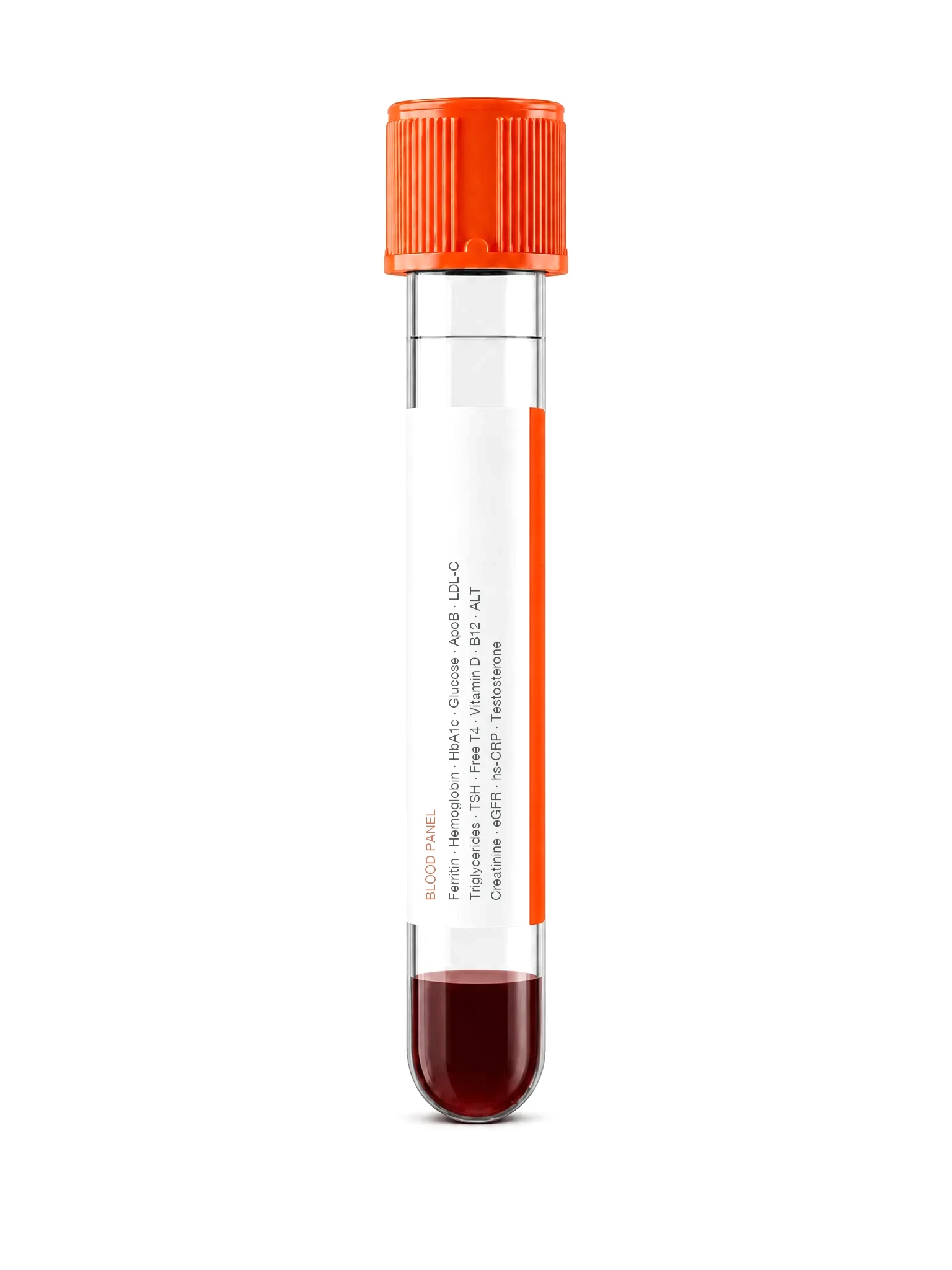

Questions
How much does a blood test cost without insurance?
The lab's underlying cost is low: Medicare pays under $20 for each of the core five tests (CBC, CMP, lipid panel, HbA1c, TSH) and about $58 for all five. Cash prices add markup and any draw or order fee. Discount ordering sites usually come closest to that baseline, a lab's own consumer site costs more, and a self-pay hospital lab can cost many times more. Uninsured patients can ask for a Good Faith Estimate before scheduled care.
Can I order my own blood work without a doctor?
In most US states, yes. Ordering sites include a physician order in the price, then you go to a Quest or Labcorp draw site. Some states restrict consumer-ordered tests and rules change, so check the seller's state list first.
Does insurance cover routine blood work?
Most private plans must cover USPSTF-recommended preventive screening with no cost sharing. That includes diabetes screening for adults 35 to 70 with overweight or obesity and the lipid testing used for statin decisions. The CBC, CMP and TSH are not USPSTF screening tests, so they may be billed. Ask your plan whether the labs will be billed as preventive. Labs ordered to investigate a symptom are billed as diagnostic and can count toward your deductible.
Is Quest or Labcorp cheaper?
Neither is reliably cheaper. Prices depend more on the seller than the lab: discount ordering sites that buy from either lab are usually cheaper than Quest Health or Labcorp OnDemand direct. Compare the full basket total at checkout.
Is an at-home finger-prick test as good as a lab draw?
For a few markers it can be close, but finger-prick drops vary from one drop to the next for blood counts, and most kits cannot run the full core five. A venous draw at a patient service center is the more reliable choice for a full panel. Are at-home blood tests accurate covers which tests hold up.
Do I need to fast before a cheap blood panel?
Only for some tests. A lipid panel can usually be drawn non-fasting, while fasting glucose and insulin need an overnight fast. Check each test's instructions before the draw so you do not pay to repeat it; how to prepare for a blood test lists them.
Citations
- Hsia RY, Akosa Antwi Y, Nath JP, Baker LC. Variation in charges for 10 common blood tests in California hospitals: a cross-sectional analysis. BMJ Open 2014;4:e005482
- HealthCare.gov. Preventive health services covered without cost sharing (Public Health Service Act section 2713)
- US Preventive Services Task Force. Screening for prediabetes and type 2 diabetes. JAMA 2021;326(8):736-743
- US Preventive Services Task Force. Statin use for the primary prevention of cardiovascular disease in adults. JAMA 2022;328(8):746-753
- Demay MB et al. Vitamin D for the prevention of disease: an Endocrine Society clinical practice guideline. J Clin Endocrinol Metab 2024;109(8):1907-1947
- Centers for Medicare and Medicaid Services. Clinical Laboratory Fee Schedule, 2025 national limitation amounts
- Centers for Medicare and Medicaid Services. No Surprises Act: Good Faith Estimates for uninsured or self-pay patients
Educational context only, not medical advice or a diagnosis. Always discuss your results with a clinician.