- 01Low BUN or high creatinine
A low ratio comes from one of two places. A low BUN points to diet, fluids, pregnancy or the liver; a high creatinine points to muscle, creatine, a meat meal, some drugs or muscle breakdown. Your two separate numbers tell you which.
A low BUN/creatinine ratio is usually a diet, fluid or muscle finding, not a kidney warning. The ratio is one number divided by another, so a lower BUN/creatinine ratio than your lab's range can come from either end. Blood urea nitrogen (BUN) is the waste nitrogen your liver makes when it breaks down protein; creatinine is the waste your muscles release at a steady rate. Read those two numbers on their own first: they tell you which side moved, and each side has a different list of causes. You will also see eGFR (estimated glomerular filtration rate), a score worked out from creatinine, age and sex that estimates how well your kidneys filter; 90 or above is normal and under 60 is low.
Where an example ratio of 8 fallsratio (BUN ÷ creatinine, US units)
The usual adult BUN/creatinine ratio is about 10:1 to 20:1 1, and individual labs set their own limits; some print a range as wide as 6 to 22. A ratio of 8 can be flagged low on one report and sit inside another lab's range, which is one reason the ratio alone settles very little. The background on the marker itself is on the BUN/creatinine ratio page.
First, look at your two numbers
Every low BUN/creatinine ratio fits one of three patterns. Find yours in the table, then read the section that matches it.
| Pattern | Example values | Usual causes | Next step |
|---|---|---|---|
| Low BUN, normal creatinine | BUN 6, creatinine 0.8, ratio 7.5 | Low protein intake, lots of fluid, pregnancy, liver disease, SIADH (the body holding too much water) | Check protein intake, sodium, albumin and liver enzymes |
| Normal BUN, high creatinine | BUN 14, creatinine 1.5, ratio 9.3 | Muscle mass, creatine, a cooked-meat meal, some drugs, muscle breakdown | Retest after a normal day; ask about cystatin C (a second kidney test that muscle does not affect) |
| Both high, creatinine more so | BUN 40, creatinine 4.0, ratio 10 | Injury inside the kidney itself | eGFR, urine albumin, and prompt medical review |
 CalculatorBUN to creatinine ratio calculatorPut in your BUN and creatinine, in US or SI units, to see the ratio and which number is out of range.Work it out
When BUN is the low one
Urea is made in the liver from ammonia, the nitrogen left over when protein is broken down. Less protein in, or a liver that makes less urea, means a lower BUN while creatinine stays put, and the ratio falls 1. Low blood urea nitrogen on its own most often points to diet or fluid.
- Low protein intake. A vegan, very low-protein or calorie-restricted diet, or malnutrition, lowers urea production and BUN 1.
- Plenty of fluid. The kidneys reabsorb some urea along with water, but not creatinine. With a lot of fluid on board, or IV fluids, less urea is reabsorbed, more is cleared, and the ratio falls.
- SIADH (syndrome of inappropriate antidiuresis, where the body holds on to too much water). Plasma BUN and uric acid are typically low because of the extra fluid and higher clearance, and blood sodium is low too 2.
- Pregnancy. GFR (glomerular filtration rate, how much blood the kidneys filter each minute) rises by about 50% from early pregnancy, so BUN and creatinine both fall below non-pregnant values 3.
- Severe liver disease. A damaged liver makes less urea, so BUN drops while creatinine does not 1. Low albumin often travels with it, and a high ammonia can too.
- Recent dialysis. Dialysis clears urea faster than creatinine, so a draw shortly after a session reads low.
- Urea cycle disorders. These rare inherited conditions give a high ammonia with a low urea 9.
Read these beside a low ratio
If your albumin is also below range, see what usually drives a low albumin. BUN read on its own has its own page: blood urea nitrogen.
When creatinine is the high one
Creatinine comes from creatine in muscle. More muscle, more creatine or more creatinine in the diet raises serum creatinine without any change in how well the kidneys filter, and that lowers the ratio 7.
- Muscle mass and heavy training. Muscular people make more creatinine every day 7.
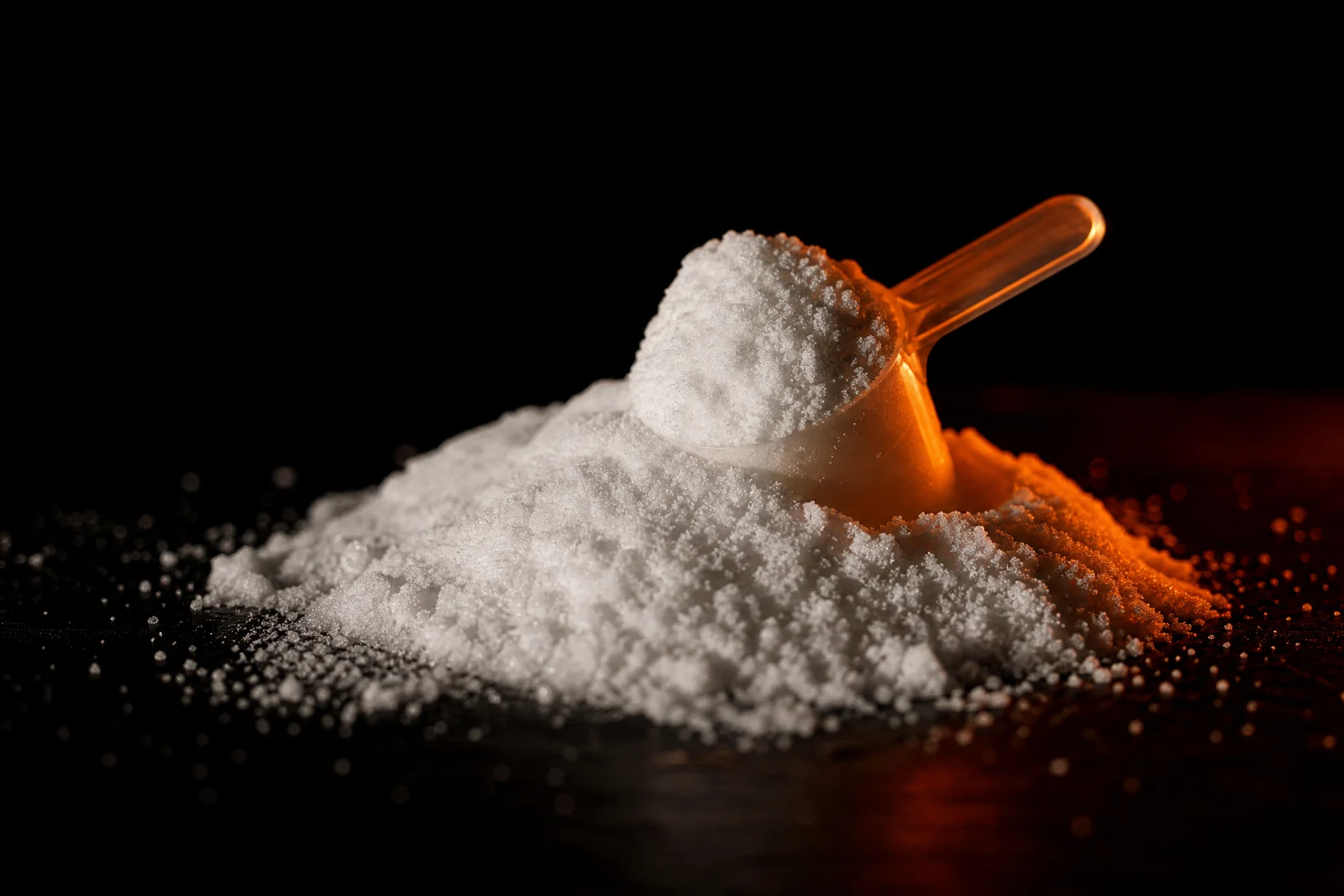
- Creatine supplements. Creatine raises serum creatinine; trials in healthy adults have not found a loss of kidney function, but a creatinine-based eGFR can look falsely low 4.
- A cooked-meat meal in the hours before the draw. Cooking turns meat creatine into creatinine, which is absorbed and lifts the blood level for several hours 7.
- Some drugs and lab methods. The antibiotic trimethoprim and the stomach drug cimetidine stop the kidneys pushing creatinine out into the urine, so the number rises while filtration is unchanged. An older lab method (Jaffe) can also read high with ketones or some cephalosporin antibiotics 7.
- Rhabdomyolysis (fast muscle breakdown after extreme exercise, a crush injury, heat or some drugs). Damaged muscle releases creatine and creatinine, so creatinine can climb faster than BUN 8.
The supplement most likely behind a high creatinine
Can a low ratio mean kidney damage?
Sometimes, but it looks different. In acute tubular necrosis, a sudden injury to the kidney's own filtering tubes, the kidneys stop clearing both wastes, so BUN and creatinine both climb and the ratio sits near 10:1 or lower 1. That pattern looks nothing like a fit person's low ratio: both numbers are well above range and eGFR has dropped.
The ratio is also a weak tool for sorting kidney problems. In a study of patients with acute kidney injury, the BUN/creatinine ratio did not reliably separate dehydration-type causes from kidney-tissue causes, and tracked more closely with how sick patients were and how much protein they were breaking down 5. What settles a kidney question is eGFR, urine albumin and the trend across two or more tests. Chronic kidney disease means an eGFR below 60, or signs of kidney damage such as albumin in the urine, lasting more than three months 6. The kidney function explainer and the chronic kidney disease page go further.
Is a low BUN/creatinine ratio dangerous?
No single ratio counts as dangerously low. A ratio of 6 with BUN 5 and creatinine 0.8 in a healthy vegetarian is a diet finding; a ratio of 10 with BUN 50 and creatinine 5.0 points to serious kidney trouble and needs prompt medical review. The BUN and creatinine values behind the ratio set the risk.
Worked examples
| Who | BUN (mg/dL) | Creatinine (mg/dL) | Ratio | What it means |
|---|---|---|---|---|
| Lifter taking creatine | 12 | 1.4 | 8.6 | Creatinine is high from muscle and creatine. eGFR can read low; if cystatin C is normal, that points to muscle and creatine rather than the kidneys. |
| Low-protein eater | 6 | 0.8 | 7.5 | BUN is low from diet. Creatinine and eGFR are normal. |
| Second trimester of pregnancy | 7 | 0.5 | 14 | Both numbers fall because GFR rises about 50%. The ratio can stay in range while each value reads low 3. |
In SI units
UK, European and Australian labs report urea in mmol/L and creatinine in µmol/L, and the ratio is urea divided by creatinine, times 1,000. On that scale the usual range is roughly 40 to 80, and some UK labs go up to 100; a US ratio of 10 equals about 40. To turn urea into BUN, multiply urea (mmol/L) by 2.8; to turn creatinine into mg/dL, divide µmol/L by 88.4. The lab units guide explains the conversions in more detail.
| US ratio (BUN/creatinine) | SI ratio (urea/creatinine × 1,000) |
|---|---|
| 6 | about 24 |
| 10 | about 40 |
| 20 | about 81 |
What usually happens next
- 1Repeat the test on a normal dayEat and drink as usual, skip a hard workout for 48 hours and a large meat meal the evening before; the blood test prep guide covers the rest. If the rest of your panel is normal and you feel well, a repeat in a few weeks or at your next routine check is usually enough. If creatinine is above range or rising, ask for a repeat with eGFR within days to a week or two.
- 2Say what you takeTell whoever orders the test about creatine, trimethoprim, cimetidine or recent antibiotics, since each can lift creatinine.
- 3Ask about cystatin C if muscle is the questionKDIGO suggests confirming eGFR with cystatin C when creatinine is less reliable, such as at extremes of muscle mass 6. The cystatin C vs creatinine comparison sets out when the second test changes the answer.
- 4Check liver and protein if BUN is the low oneAlbumin, ALT and a look at daily protein intake usually explain a low BUN. Very low sodium points toward SIADH.
We suggest using eGFRcr-cys in clinical situations when eGFRcr is less accurate and GFR affects clinical decision-making.

Talk any change to diet, supplements or medicines through with your doctor first, especially with liver or kidney disease. What moves the ratio back depends on the side that moved it. A low BUN from diet rises when protein intake rises; a high creatinine from a meat meal fades within about a day, while one from creatine can take several weeks to settle after stopping. A low ratio from pregnancy returns to the usual range after delivery. The full panel this ratio comes from is laid out in the metabolic panel explainer.

Citations
- Hosten AO. BUN and Creatinine. In: Walker HK, Hall WD, Hurst JW, eds. Clinical Methods, 3rd ed. Butterworths, 1990.
- Ellison DH, Berl T. The syndrome of inappropriate antidiuresis. N Engl J Med 2007;356:2064-72.
- Cheung KL, Lafayette RA. Renal physiology of pregnancy. Adv Chronic Kidney Dis 2013;20(3):209-14.
- Longobardi I et al. Is it time for a requiem for creatine supplementation-induced kidney failure? A narrative review. Nutrients 2023;15(6):1466.
- Uchino S, Bellomo R, Goldsmith D. The meaning of the blood urea nitrogen/creatinine ratio in acute kidney injury. Clin Kidney J 2012;5(2):187-91.
- KDIGO 2024 Clinical Practice Guideline for the Evaluation and Management of Chronic Kidney Disease. Kidney Int 2024;105(4S):S117-S314.
- Delanaye P, Cavalier E, Pottel H. Serum creatinine: not so simple! Nephron 2017;136(4):302-8.
- Bosch X, Poch E, Grau JM. Rhabdomyolysis and acute kidney injury. N Engl J Med 2009;361:62-72.
- Häberle J et al. Suggested guidelines for the diagnosis and management of urea cycle disorders: first revision. J Inherit Metab Dis 2019;42(6):1192-1230.
Educational context only, not medical advice or a diagnosis. Always discuss your results with a clinician.