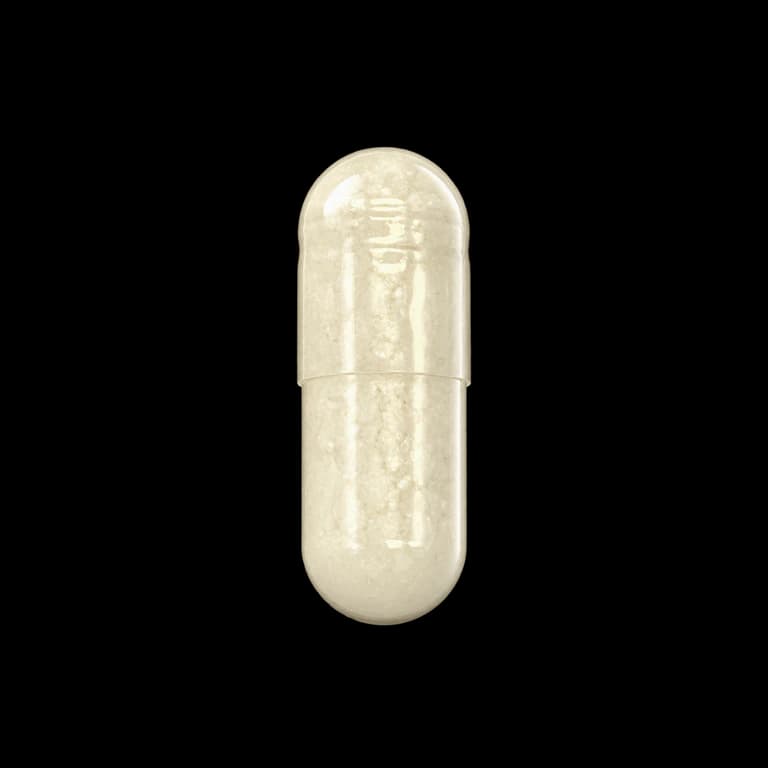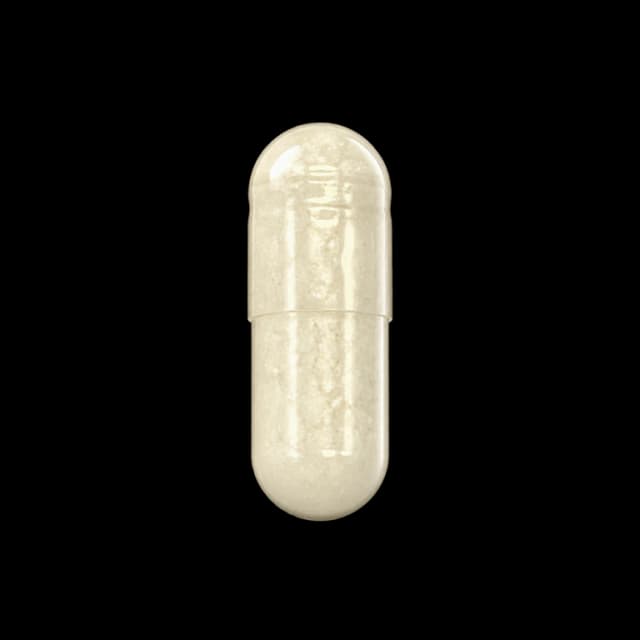
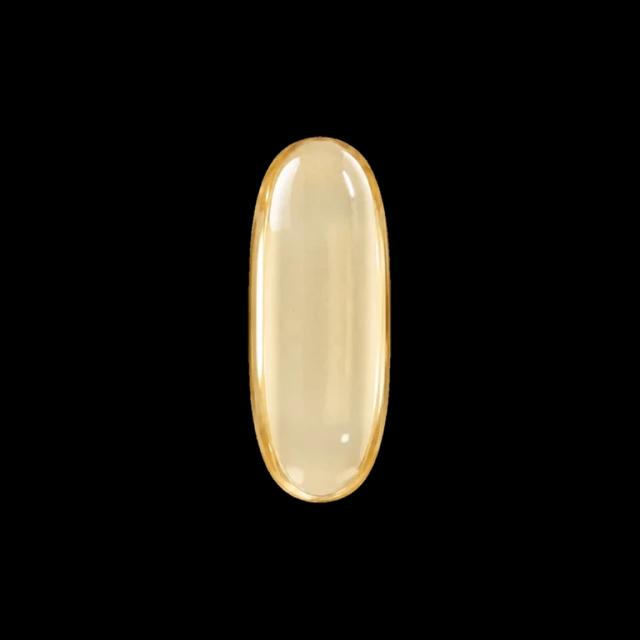
Vitamin D3 (cholecalciferol) and vitamin D2 (ergocalciferol) both raise the vitamin D level on your blood test, but D3 raises it further and keeps it up longer, most clearly when doses are large and spaced out. With small daily doses the gap narrows. The form also matters for the test itself: some lab methods read the D2 version of your result less accurately than the D3 version.
What is the difference between vitamin D3 and D2?
Vitamin D3 is the form human skin makes when sunlight hits it, and the form found in oily fish and egg yolk. Supplement D3 is usually made from lanolin, the grease in sheep's wool. Vitamin D2 is made by exposing ergosterol, a compound in yeast and fungi, to ultraviolet light; UV-treated mushrooms are a food source. 6 Both are measured in the same units: 1 microgram (mcg) equals 40 IU. 6
Neither form does anything until the body converts it. The liver turns both into 25-hydroxyvitamin D, written 25(OH)D, the stored form your blood test measures, and the kidneys convert that into the active hormone. D2 and D3 follow the same steps, but after a large dose the 25(OH)D made from D2 falls away sooner than the 25(OH)D made from D3. 3 The 25(OH)D marker page explains the test in full.
Vitamin D deficiency is judged by a blood test for 25-hydroxyvitamin D (25(OH)D, the stored form that reflects your vitamin D supply).
Vitamin D3 and D2 side by side
Does D3 raise vitamin D levels more than D2?
Mostly yes, and the size of the gap depends on how the dose is given. A 2012 meta-analysis in the American Journal of Clinical Nutrition pooled the randomised trials that compared the two forms directly. D3 raised 25(OH)D significantly more than D2 overall. When the trials were split by dosing pattern, the advantage was clear for large bolus doses (one big dose given at intervals) and was lost with daily dosing. 1
The bolus result shows up most clearly in a 2004 study by Armas, Hollis and Heaney. Twenty healthy men took a single 50,000 IU dose of D2 or D3. Both raised 25(OH)D for the first three days, then the D2 group fell back to baseline by day 14 while the D3 group kept rising to a peak at day 14. Over 28 days, D3 produced about three times the total exposure. 3
Physicians resorting to use of vitamin D(2) should be aware of its markedly lower potency and shorter duration of action relative to vitamin D(3).Armas LA, Hollis BW, Heaney RP. J Clin Endocrinol Metab, 2004 3
Daily dosing tells a more mixed story. In a 2008 Boston University trial, adults took 1,000 IU a day of D2, D3, or half of each, for 11 weeks at the end of winter. All three groups ended at similar total 25(OH)D levels, around 27 to 29 ng/mL. 2 A larger 2017 UK trial in 335 women gave 15 mcg (600 IU) a day of D2 or D3 in fortified juice or biscuits for 12 weeks, measured by the reference method, and found D3 raised total 25(OH)D by about 15 to 17 nmol/L more than D2. 5
Why the dosing pattern changes the answer
A daily dose tops up 25(OH)D before it has time to fall, so the faster fade of D2 matters less. A weekly or monthly dose has to last until the next one, and that is where D3's longer hold shows. That fits both the meta-analysis split by dosing pattern 1 and the single-dose study, in which D2's effect had gone by day 14. 3
When the form and the test disagree
The vitamin D blood test is where the choice of form causes the most confusion. A 25(OH)D result is meant to be the total of 25(OH)D3 and 25(OH)D2. Not every method counts both equally.
A 2012 comparison in Clinical Chemistry ran 170 patient samples on two LC-MS/MS reference methods (liquid chromatography with tandem mass spectrometry, which separates D2 from D3), a radioimmunoassay and five automated immunoassays. The automated tests varied in how closely they matched, and one of them, the Roche assay in use at the time, measured 25(OH)D3 only. 4 Assays have been updated since, but the point stands: if most of your vitamin D comes from D2, the method your lab uses can change the number.
Units add a second trap. US labs usually report 25(OH)D in ng/mL, and many other countries use nmol/L; 1 ng/mL equals 2.5 nmol/L. 6 A result of 50 means very different things in the two units, so check which one your report uses before comparing it with a study or an older result.
- You take D2 and your level barely moves. Ask whether your lab's method fully counts 25(OH)D2, and whether an LC-MS/MS test, which reports D2 and D3 separately, would help. 4
- You switched from D3 to D2 and your level dropped. D2 raises only the D2 portion of the result; in one trial, D2 did not raise 25(OH)D3 at all. 2 As your D3 portion fades, the total depends on the test counting the D2 portion properly.
- You took a big weekly dose of D2 and the level was fine a few days later but low a few weeks later. D2 levels fall faster after a large dose 3, so the timing of the blood draw relative to the dose matters.
- Two labs give different numbers for the same month. Automated vitamin D tests differ from each other 4; compare results from the same lab when you can.
Why D2 still shows up
In the US the high-dose prescription vitamin D has long been a 50,000 IU D2 capsule, so many people with a low result are handed D2 rather than D3. 3 D2 is also the traditional choice for vegans, because most D3 comes from lanolin, though D3 made from lichen is now sold as a vegan option. Mushrooms exposed to UV light are a food source of D2. 6
If you were prescribed D2, questions about the form belong with the clinician who wrote the prescription. Their plan usually includes when to recheck the level, and that recheck is how they judge whether the form and dose are working.
Which one to ask about
For most people choosing an over-the-counter product, D3 is the form with the stronger evidence for raising and holding 25(OH)D. 1 D2 at daily doses works, and it may be the right choice for a vegan diet or the form a prescription uses. LifeFrom's vitamin D guide covers who needs a supplement at all, and the D Complex page lists what that product contains.
- 1Do I need a supplement, or a test?Ask whether your diet, sun exposure, age or a condition puts you at risk, since routine testing is not recommended for healthy adults. 7
- 2Which form is my prescription?Ask whether it is D2 or D3 and how often to take it, since large spaced-out doses favour D3. 1
- 3Does our lab count D2 fully?If you take D2, ask whether the lab method measures 25(OH)D2 as well as D3. 4
- 4When should we recheck?Ask when the next level should be drawn, so the result reflects your usual intake and not the days after a big dose.
The plain takeaway: both forms raise vitamin D, D3 raises it further and longer when doses are large and spaced out, and the test only tells the full story if it counts D2. If you take D2, say so when your blood is drawn.

Questions
Is vitamin D3 better than D2?
For raising and holding blood 25(OH)D, D3 generally does better. A 2012 meta-analysis found D3 more effective overall, with the clearest gap for large, infrequent doses. With 1,000 IU a day, one trial found the two equal, while a trial at 600 IU a day in food found D3 better.
Why do doctors prescribe vitamin D2 50,000 IU?
In the US, the long-standing high-dose prescription vitamin D has been a 50,000 IU ergocalciferol (D2) capsule. If you were prescribed it, questions about the form or when to recheck go to the prescriber.
Does the vitamin D blood test measure D2?
It is meant to report total 25(OH)D, the sum of the D2 and D3 forms. Some methods underread or miss the D2 portion. LC-MS/MS testing reports the two separately. If you take D2, tell whoever orders the test.
Is vitamin D3 vegan?
Most D3 is made from lanolin, the grease in sheep's wool, so it is not vegan. D3 made from lichen is sold as a vegan option, and D2 from yeast or UV-treated mushrooms is vegan.
Can I switch from D2 to D3?
If your vitamin D was prescribed, ask the prescriber before changing, because the dose and recheck plan were set for that form. If you buy an over-the-counter product, D3 is the form with stronger evidence for raising levels.
How are IU and mcg related for vitamin D?
One microgram (mcg) of vitamin D equals 40 IU, for both D2 and D3. So 25 mcg is 1,000 IU.
Citations
- Tripkovic L, Lambert H, Hart K, et al. Comparison of vitamin D2 and vitamin D3 supplementation in raising serum 25-hydroxyvitamin D status: a systematic review and meta-analysis. Am J Clin Nutr. 2012;95(6):1357-1364.
- Holick MF, Biancuzzo RM, Chen TC, et al. Vitamin D2 is as effective as vitamin D3 in maintaining circulating concentrations of 25-hydroxyvitamin D. J Clin Endocrinol Metab. 2008;93(3):677-681.
- Armas LA, Hollis BW, Heaney RP. Vitamin D2 is much less effective than vitamin D3 in humans. J Clin Endocrinol Metab. 2004;89(11):5387-5391.
- Farrell CJ, Martin S, McWhinney B, et al. State-of-the-art vitamin D assays: a comparison of automated immunoassays with liquid chromatography-tandem mass spectrometry methods. Clin Chem. 2012;58(3):531-542.
- Tripkovic L, Wilson LR, Hart K, et al. Daily supplementation with 15 μg vitamin D2 compared with vitamin D3 to increase wintertime 25-hydroxyvitamin D status in healthy South Asian and white European women: a 12-wk randomized, placebo-controlled food-fortification trial. Am J Clin Nutr. 2017;106(2):481-490.
- NIH Office of Dietary Supplements. Vitamin D: fact sheet for health professionals.
- Demay MB, Pittas AG, Bikle DD, et al. Vitamin D for the prevention of disease: an Endocrine Society clinical practice guideline. J Clin Endocrinol Metab. 2024;109(8):1907-1947.
Educational context only, not medical advice or a diagnosis. Always discuss your results with a clinician.